Sunday, 7 March 2021

Update

 Unfortunately I've been rather poorly over the last few days and not feeling up to posting. I think I'm on the mend now, though. Tomorrow I should be receiving the Season 8 box set, so I'm going to concentrate on watching that as I recuperate this week, and I'll be back with a review of the box set next weekend. 
See you then.

Tuesday, 2 March 2021

J is for... Jaeger, Professor

 
Jaeger was a somewhat inept and amoral scientist who was in the employ of the Marshal of Solos. The Marshal ruled the planet Solos on behalf of the Earth Empire, which was then in decline. The Marshal used Jaeger to conduct experiments to make Solos' atmosphere breathable by humans, so that it could be fully colonised, irrespective of the harm it might do to the native peoples.
When the Doctor arrived on a mission for the Time Lords, he was forced to help the professor, but found that he could easily trick him as he did not know half of what he claimed to know. Occasionally Jaeger would stand up to the Marshal, but would always then follow his orders.
One of the Doctor's ruses was to sabotage the machine which would alter Solos' atmosphere, which the Marshal insisted Jaeger operate, and the professor was killed when it exploded.

Played by: George Pravda. Appearances: The Mutants (1972).
  • Pravda had earlier played Alexander Denes in The Enemy of the World, and would return to the series in 1976 as Castellan Spandrell, in The Deadly Assassin.
  • Writers Bob Baker and Dave Martin named the professor after their actor friend Frederick Jaeger, who they hoped might be cast in the role. Jaeger would go on to play a couple of other scientists in the series - Prof. Sorenson in Planet of Evil, and Prof. Marius, creator of K9, in The Invisible Enemy, having previously played Jano in The Savages.

J is for... Jacondans

 
A race of bird-like humanoids from the planet Jaconda. This idyllic world had for many years been ruled by a Time Lord named Azmael, who at one point had been visited by the Fourth Doctor. An ancient legend told of how the planet had once been blighted by giant slug-like creatures called Gastropods, which devoured all the vegetation and left the population starving. This had been caused when the queen of the planet had slighted their sun god. The sun god relented and destroyed the Gastropods. However, the story was more than mere myth. One Gastropod egg had survived and this resulted in Mestor, a Gastropod with great mental powers. He took over the planet and his people once again laid waste to it. Once again the Jacondans starved, and anyone caught stealing food was executed by Mestor, aided and abetted by his unctuous Jacondan Chamberlain.


Azmael was forced to work with Mestor on a scheme to use neighbouring planets as food sources for Jaconda - bringing them into closer orbit with their sun. Azmael abducted a pair of mathematically gifted twins - Romulus and Remus Sylvest - from Earth to help achieve this. Azmael was given two Jacondans as helpers in this task, the friendly Noma and the duplicitous Drak. The newly regenerated Sixth Doctor stumbled into this scheme, along with companion Peri and an Earth space security officer named Hugo Lang.
The Doctor realised that Mestor's true scheme was to destroy Jaconda and its neighbouring planets in a cosmic explosion which would send millions of Gastropod eggs across space to colonise other worlds.
Mestor killed Noma after using him to psychically spy on the Doctor and Azmael. Once the Gastropod had been defeated, the treacherous Chamberlain attempted to escape the planet but Lang refused to allow him to take the TARDIS. Azmael had died in defeating Mestor, and Lang decided to stay on as the new ruler.

Played by: Oliver Smith (Drak), Barry Stanton (Noma), Seymour Green (Chamberlain). Appearances: The Twin Dilemma (1984).
  • Seymour Green had earlier played Harrison Chase's butler Hargreaves in The Seeds of Doom.
  • As I pointed out in my review of this story, it is very odd that the Time Lords would have allowed one of their own to rule another planet, even if benignly. A relatively junior space security officer then just sets himself up as new ruler, and the Doctor - who has only known him a short time - doesn't see anything wrong with this.

J is for... Jackson, Maria


Maria Jackson was a schoolgirl who moved into a house on Bannerman Road, Ealing, with her father after her parents - Alan and Chrissie - had split up. The house was across the road from the home of Sarah Jane Smith. One night Maria saw strange lights coming from Sarah's garden, and witnessed her meeting with an alien being. Sarah had initially been reluctant to engage with the Jacksons, but their paths crossed when Maria and her friend Kelsey visited the new Bubble Shock! soft drinks factory, which Sarah was investigating. The factory was cover for an alien species called the Bane, who were planning to use their drink to take over everyone who drank it. Maria did not like it, so was immune to its effects. To refine the drink's effects, the leader of the Bane - Miss Wormwood - had created a human boy. Sarah and Maria rescued him, and he would become Sarah's adopted son Luke. After the Bane attacked Sarah's home, Sarah had no choice but to include Maria in her work. After the factory had been blown up, Maria and Luke started their new school - Park Vale. Here they met and befriended fellow pupil Clyde Langer. They discovered that the Headmaster and some of the teachers were disguised Slitheen, out for revenge after the destruction of their kin in the Downing Street explosion. The Slitheen planned to shut down the sun. Maria helped Sarah defeat them, along with Clyde and Luke.
Some time later Maria befriended an old lady named Bea at the Lavender Lawns retirement home, and learned that she had encountered aliens in her youth. She possessed an amulet which the alien Gorgons were seeking, in order to invade the Earth. At one point Maria's father was turned to stone by the Gorgon, but the amulet cured him.
Maria then helped Sarah defeat General Kudlak's plan to abduct children from gaming arcades to fight an interplanetary war - an adventure which allowed her to visit outer space and see the Earth from above.
Sarah gifted Maria an alien box, which - during the night - protected her from the Trickster removing Sarah from time and replacing her with an old school friend, Andrea Yates. As schoolchildren, Andrea had died in an accident, and the Trickster allowed her to swap with Sarah. Only Maria could remember Sarah, and know that time had been changed. Later the Trickster had Maria removed from time, but this time her father had been protected by the alien box. He forced the Trickster's Graske servant to return Maria, and later Sarah was able to convince Andrea to swap back before the Earth was destroyed by a meteorite. It was during this adventure that Alan found out about his daughter's dealings with aliens, and he threatened to move them away from the area. 
However, Alan was on hand to help his daughter when they had another encounter with the Slitheen - this time attempting to crash the Moon into the Earth.
Maria and Alan were on holiday in Cornwall when the Daleks and Davros moved the Earth out of its orbit to the Medusa Cascade.
Alan then announced that he had been offered a new job in the United States, and Maria had to inform Sarah she would be leaving. Unhappy at her departure, Sarah at first shunned Maria when they were called upon to investigate strange happenings at the Goblins Copse space research station. This proved to be the work of a lone Sontaran survivor of their recent failed attempt to turn Earth into a clone breeding planet. Sarah later apologised for her attitude towards her, as she had come to admire her and did not want to lose her.
Maria continued to stay in contact with Luke, Sarah and Clyde, and their new friend Rani, who had moved into her old home - including assisting with tracing Clyde when his father was taken over by a Berserker artefact. They were unable to attend Sarah's wedding, but Maria remained in touch with Luke for years afterwards.

Played by: Yasmin Paige. Appearances: SJA Pilot - Invasion of the Bane (2007), SJA Series 1 (2007), SJA 2.1 The Last Sontaran (2008), SJA 2.4 The Mark of the Berserker (2008).
  • Paige left the series after one season as she wished to concentrate on her education.
  • She was reunited with Tommy Knight (Luke) in 2014 when they both appeared in the E4 rural crime drama Glue.
  • Paige was also heard, but not seen, as Maria in the Series 2 story Day of the Clown, when she was heard on a phone call with her old gang.

Saturday, 27 February 2021

Fortean Who (3)


The latest issue of Fortean Times (FT403 March 2021) has a small article about unusual ghosts - unusual as in non-humanoid. As well as a haunted lamppost, and a giant luminous crab, there is a tale as recounted by Third Doctor Jon Pertwee, of a ghostly encounter he had as a small boy.
He was the guest of a school friend at an Elizabethan house in Sussex. There were many other guests, and the friend he was staying with seemed uncertain about the room that Pertwee was to sleep in. The boy's mother assured him it would be okay as children tend to be deep sleepers.
On the first night, Pertwee woke up feeling nauseous, and threw up over the bedclothes. He had no explanation for this illness, which soon passed.
The next night however, he woke up to smell a terrible stench in the room, as of rotten meat. He then witnessed a glowing green object, similar to a tree stump, at the foot of the bed, which moved slowly across the room. He was so frightened that he wet himself and ran out of the room to where others were sleeping.
The family were obviously aware of this apparition but thought that, as a child, he would sleep through any manifestation.
Now Pertwee was a great story-teller, especially if it involved himself, and he would often elaborate and expand on his own role in the narrative. What makes this story sound plausible is the strangeness of the thing he saw (and smelled). Most kids making up ghost stories would have gone for the headless Tudor, or the hooded monk, or the spectral lady in white - something traditional being more likely to be believed. The sheer bizarreness of Jon's experience suggests that it might possibly have been true. Who knows...?

Friday, 26 February 2021

Inspirations - The Curse of Fenric


The Curse of Fenric wears its inspirations on its sleeve. There are three main ones that can be clearly seen, plus the story also has to develop - though not quite end - the story arc of Ace.
The first inspiration is vampire stories in general, and the Dracula story in particular.
The monsters of the piece are known as Haemovores - as in eaters of blood. Haima is Greek for blood, and the prefix haemo- derives from this.
We don't see any fangs, though the creatures do make a beeline for Ace's throat when she is threatened by them on the roof of the church. Other victims are found drained of blood. The Haemovores are reanimated corpses. They can be destroyed by being staked through the heart, their bodies disintegrating. Whilst some of their victims appear to die, others are transformed into Haemovores themselves. In vampire cinema, victims either die or are 'turned', depending on what the plot wants to do with the character.
The legend of the Ancient One tells how it followed a vase from the Middle East to Britain (the one in which Fenric's essence was trapped). Mention is made of how this route took it through the forests of Eastern Europe - suggesting that this is where the traditional vampire stories of Transylvania and its neighbours originated, and from where Bram Stoker took his inspiration.
The location where the vase ends up is stated to be the North East coast of England. It was at the Yorkshire fishing town of Whitby that Dracula first came ashore in England in Bram Stoker's 1897 gothic horror tale.
Instead of a supernatural, occult background for these vampires, they are the result of pollution on a future, possibly alternate, Earth.
Objects like crucifixes in themselves don't harm the Haemovores - only the faith of the bearer. The Rev Wainwright can hold them back until they destroy his faith in humanity with talk of British bombs falling on German cities. Captain Sorin holds them back with his faith in the Russian Revolution, whilst the Doctor recites the names of his companions in whom he has always had total faith. The Doctor has to destroy Ace's faith in him so that she won't prevent the Ancient One from attacking Fenric.
The 1968 Hammer film Dracula Has Risen From The Grave features a scene wherein the young hero stakes Dracula through the heart, even though there's 20 minutes of the movie still to run. The young man is an atheist and his lack of faith allows the Count to pull the stake out and escape. (Apparently Christopher Lee hated this scene, as he simply felt that a stake through the heart kills vampires, full stop).
The Ancient One is called upon by Fenric to destroy the other Haemovores once their usefulness is at an end. In the movies at least, Dracula often discards and destroys his servants once he no longer needs them.


The second inspiration for this story is the work of the World War Two code-breakers, in particular Alan Turing and the Bletchley Park group. Even Turing's homosexuality is hinted at, as there seems to be an implication that Commander Millington and Professor Judson may have been more than just classmates at school.
Mathematician Turing was born in London in 1902. Following spells at Cambridge and Princeton, in 1938 he joined the Government Code and Cypher School. He moved to Bletchley Park in 1939, working in Hut 8. His main work was in trying to crack the Nazi Enigma Machine, for which he developed an early computer known as the bombe. The main purpose for this work was to crack the codes used by the German U-Boats, which were sinking huge numbers of allied ships.
Immediately after the war, Turing was awarded the OBE and he went on to further develop computing machines and research artificial intelligence.
In early 1952 a burglary at his home revealed to the authorities that he was gay (the burglar being an acquaintance of his boyfriend). Offered a choice of prison or probation with a compulsory course of hormone treatments, he chose the latter. Two years later, in June 1954 he was found dead - having killed himself with cyanide which he had injected into an apple.
He did not get a posthumous pardon until 2014. This led to a wider pardon for men convicted of historical homosexual acts in 2016.
In The Curse of Fenric we see Professor Judson working on his Ultima Machine, to crack German U-Boat codes. As at Bletchley Park, we also have a team of women (WRENS in this case) carrying out some of the work.


The third inspiration for this story is Norse Mythology. There is a sunken Viking ship in the bay off Maiden's Point, and the Haemovores and all of the key characters in this story are the descendants of Viking settlers in the area - even Ace. It was Viking traders who found Fenric's vase in the Middle East and brought it to Yorkshire, with the Ancient One following. It is now known through archaeological finds that the Vikings travelled widely - from the Middle East to the Americas.
Millington is a great fan of Norse mythology, and mentions the great battle at the end of the world. Ragnarok itself is not named, as producer JNT thought it might confuse fans after the Gods of Ragnarok had featured in the previous season. Writer Ian Briggs had been inspired by a visit to Sweden to include these Viking references. Fenric derives from Fenrir, the great wolf monster, and Millington also mentions the great world tree (Yggdrasil), and the toxin which he plans to use as a biological weapon is said to derive from the poison of a great serpent (presumably Jormungandr).
Historically, the Vikings raided the north east coast of England where this story is set, before finally settling the area.


As mentioned, even Ace is one of the "wolves" of Fenric. One of the WRENS is a young woman named Kathleen Dudman, who has her small baby with her. Ace finds herself smitten with the child, though she dislikes her name - Audrey. What we knew of Ace up until now was that she had been transported to Iceworld by a time storm which suddenly materialised in her bedroom. There has never been any mention of her father, and she hates her mother, whose name is Audrey. Her own name, which she also dislikes, is Dorothy. Seemingly unrelated, the Doctor was intrigued by a game of chess which was in progress at the home of Lady Peinforte in Silver Nemesis.
When the Haemovores attack the base, Ace sends Kathleen to safety at her grandmother's house in South London, having earlier heard that her husband was missing, presumed dead, at sea. Later Fenric, now inhabiting Sorin's body, reveals that Ace has inadvertently set up her own existence. The baby whom she adores will become the mother she hates. Ace is as much a pawn of Fenric as Sorin, Judson, Millington and Wainwright. As Briggs had helped to create the character, so he was permitted to help resolve her story. It also transpires that the chess game which so intrigued the Doctor was the one he had played against Fenric, and the Doctor has seen Fenric's hand behind Ace right from the start. Ace's story isn't quite finished yet, as we'll see next time...

Tuesday, 23 February 2021

Story 238 - The Crimson Horror

   
In which Madame Vastra is approached by a man named Mr Thursday, who wishes her to investigate the bizarre circumstances surrounding the death of his brother, Edmund. He was found dead in a river in Yorkshire, his body rigid and and its flesh turned bright red. Vastra visits the morgue, where the ghoulish attendant has termed the condition the "Crimson Horror". She uses an optogram - photographing the dead person's eyes as it is believed that they might hold an image of the last thing they saw.
She is shocked to see an image of the Doctor's face, his skin bright red...
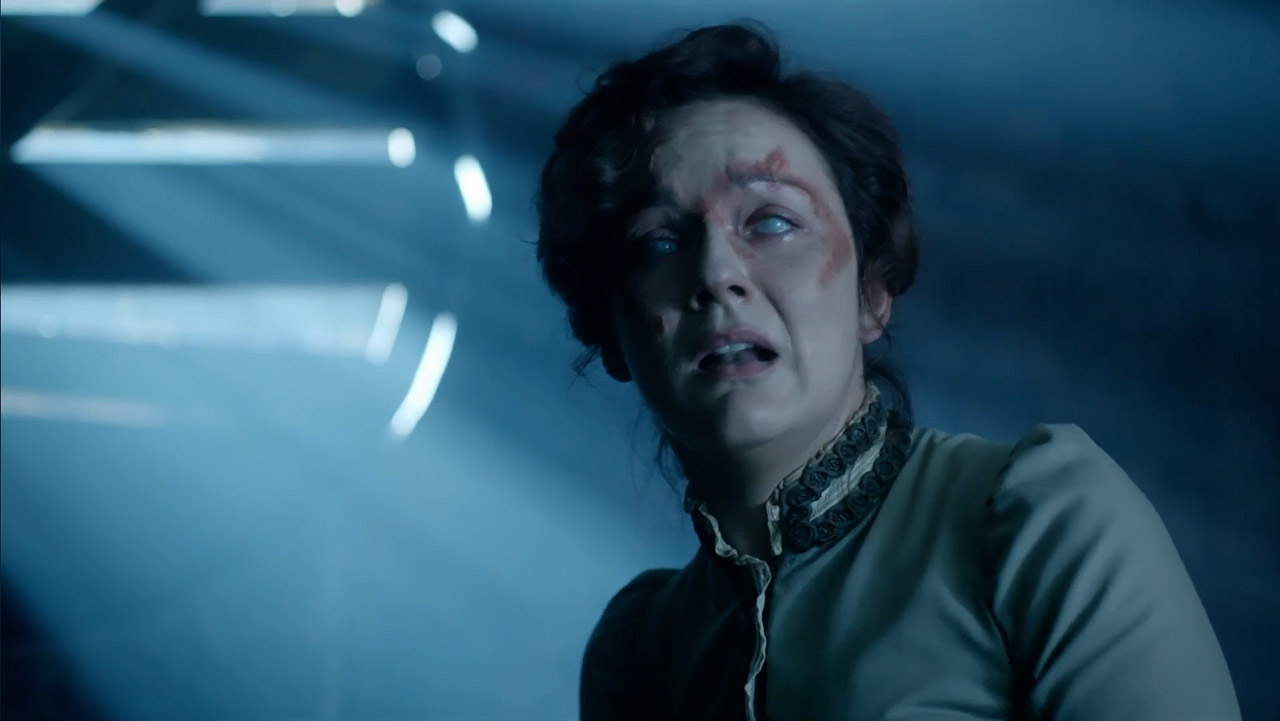
Edmund was a journalist who was investigating an industrial new town called Sweetville. This is run by a woman named Mrs Gillyflower, and her secretive business partner Mr Sweet. She has been leading a popular moral crusade - claiming that the end of their decadent society is nigh. She has been recruiting followers, all of whom tend to be good looking young men and women. Jenny Flint is despatched to Yorkshire to infiltrate the factory as a prospective follower.She sneaks off to explore and discovers that the factory is an empty shell, the sounds of machinery being played on a huge gramophone recording. Another chamber hold massive vats of bright red liquid, and numbers of young people are seen being dipped into these. In a storeroom she finds the Doctor locked away, his flesh red and his limbs rigid, almost unable to speak or walk. As Jenny rescues him she is almost stopped by the arrival of a young woman who is blind and disfigured. This is Mrs Gillyflower's daughter Ada.                                       
                                                          

The Doctor has Jenny take him to a small chamber where he is restored to normal. Mrs Gillyflower's people attack them, but Jenny overpowers them.
It transpires that the Doctor and Clara had visited Sweetville some days ago, after being approached by Edmund Thursday for help. They too had gone to the factory posing as prospective followers. Some people were rejected by the process to convert them - the dipping in a vat of red liquid - and their bodies get dumped in the nearby river. Clara is found in one of the cottages, under a huge bell jar and in suspended animation.
Vastra and Strax arrive in Sweetville, and she reveals that she knows what the "Crimson Horror" is. In prehistoric times her people encountered a red leech creature, which produced a highly dangerous crimson toxin.
Ada Gillyflower is bullied and abused by her mother. She has been told that there is no place for her in her mother's promised Utopia, due to her disfigurement. She had rescued and protected the Doctor as she saw in him a monster like herself.


The Doctor and Clara confront Gillyflower and learn that she has formed a symbiotic relationship with a surviving red leech, which she calls Mr Sweet - her mysterious business partner. Her plan us to fire a missile into the skies above Sweetville, full of red leech poison. This will spread through the atmosphere killing millions, but leaving her elite group of converted people to restock the planet. Ada discovers that her injuries weren't caused by her father, as her mother led her to believe, but by Mrs Gillyflower using her as a test subject for Mr Sweet's toxin. The Doctor, Clara and the Paternoster Gang attack the missile silo in the factory, assisted by Ada. Mrs Gillyflower falls from a gantry to her death as the missile launches, but Vastra had earlier removed the poison from it. Ada then kills Mr Sweet as it tries to crawl away. Vastra will dispose of the toxin, whilst Ada will live a new life, free of her mother's malign influence.
On her return to 2013, Clara has a shock in store. Her young charges - Artie and Angie - have been searching on-line and have discovered evidence of Clara's ventures into the past. One of the images, of her in Victorian costume, she does not even recognise...


The Crimson Horror was written by Mark Gatiss, and was first broadcast on 4th May, 2013. Steven Moffat had intended to write a story himself which would feature one of the Doctor's adventures as witnessed and experienced from the viewpoint of someone else - in this case the Paternoster Gang of Vastra, Jenny and Strax. Moffat was then too busy to write the story himself, and so handed it to Gatiss, who decided on a northern Victorian setting. The Doctor and Clara hardly feature in the first half of the story, as the Gang take centre stage - especially Jenny. Events leading up to the Doctor being found in his crimson state are shown in flashback. This is the only story featuring the Paternoster Gang written by someone other than Moffat.
Gatiss took as inspiration for his story title that of The Green Death, a favourite of his from the classic series.
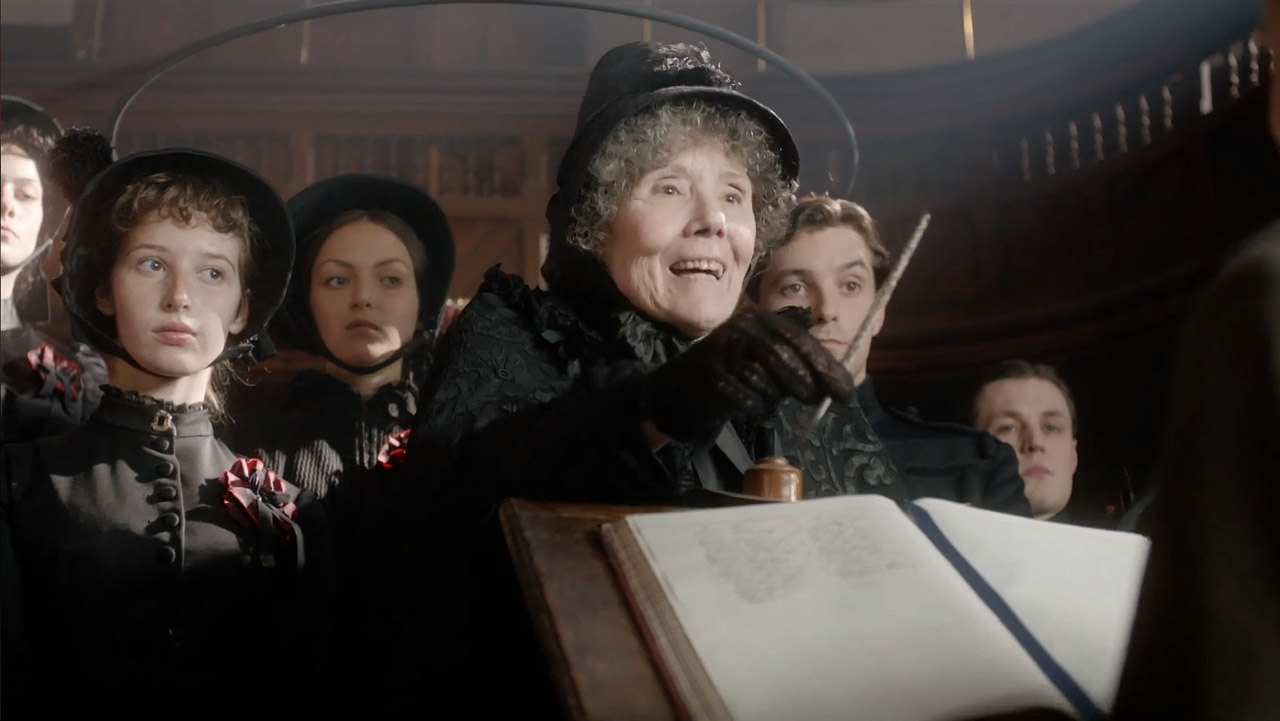
Gatiss had earlier worked on stage with Dame Diana Rigg, of The Avengers, Game of Thrones and James Bond fame, and he also knew her daughter Rachael Stirling. Mother and daughter had never worked together on screen, and so Gatiss wrote this story specifically to address this. Diana Rigg plays the formidable Mrs Gillyflower, whilst Stirling plays Ada.


The monster of the piece - the red leech - is inspired by one of the Sherlock Holmes stories, as "The Repulsive Case of the Red Leech" is referenced in The Adventure of the Gold Pince-Nez. As the red leech derives from prehistoric Earth, this is the first story in a long time to have no alien interventions.
Sweetville derives its name from Bourneville, the new town created at Birmingham for the chocolate manufacturers. It is also based on the area of Bradford known as Saltaire - another industrial new town founded by the wool magnate Titus Salt in 1851.
Other than Rigg and Stirling, the other actor worth noting is Brendan Patricks. He plays both Edmund Thursday and his unnamed brother who instigates Vastra's investigations. We should also give a mention to Jack Oliver Hudson as "Urchin Boy". He gives his name to Strax as Thomas Thomas, thus setting up a rather funny TomTom joke.


Overall, it's a fine, full-blooded bit of Victorian Grand Guignol, with some great performances. Diana Rigg really relishes the chance to go full-on nasty.
Things you might like to know:
  • Jenny's fight against Mrs Gillyflower's henchmen, clad in a leather catsuit, was a deliberate homage to Rigg's time on The Avengers.
  • Mr Sweet was named after Gatiss' friend, the broadcaster Matthew Sweet (who is currently conducting the in-depth interviews for the Complete Season Box Sets).
  • This was the 100th episode of Doctor Who since its return in 2005.
  • The story is set in 1893, yet Mrs Gillyflower and her followers are playing a 1906 version of the hymn To Be A Pilgrim (aka He Who Would Valiant Be).
  • There are a couple of Tegan Jovanka references. Mentioning that the TARDIS was better at getting where it is supposed to go, he states that he once spent a long time trying to get a gobby Australian to Heathrow Airport, and he later says "Brave Heart..." to Clara.
  • The Fourth Doctor had earlier mentioned the concept of optograms in The Ark in Space, where he does get a Wirrn's retina to show its final actions before death.
  • I strongly suspect that the idea of dipping people into a bubbling vat to preserve them comes from Carry On Screaming.