Sunday, 29 June 2025

Episode 166: The Evil of the Daleks (4)


Synopsis:
As Jamie wanders through the darkened passageways of the south wing, he sees a huge figure emerge from the shadows in front of him - Kemel...
He is unaware that Maxtible has instructed his manservant to intercept him - using lethal force. Kemel attacks him and the two fight. Jamie breaks free and dives into another room. When Kemel forces his way in, he stumbles forward and falls through the open window.
Jamie saves him from plummeting to the ground by lowering a rope to him. 
A Dalek, meanwhile, plants a handkerchief belonging to Victoria in the open doorway of the room she was previously held in. When Jamie sees it he rushes forward and triggers a lethal trap - but Kemel knocks him out of the way as a huge axe swings towards him.
In a room next to Maxtible's laboratory, these events are being monitored by the Doctor and one of the Daleks. He points out that it took great courage for Jamie to have fought with Kemel, and he also showed mercy in saving the life of his opponent. The Dalek regards the latter emotion as a weakness, but the Doctor stresses that these contribute to the "Human Factor" they seek.
Next door, Waterfield and Maxtible discover Toby's corpse, with a Dalek standing over it. Maxtible is becoming increasingly concerned about Waterfield's failing nerve, which threatens his ultimate aims in helping the Daleks. He removes a pistol from a drawer and slips it into his pocket.
Jamie and Kemel have now become friends after saving each other's lives, and so they join forces to find and rescue Victoria - an action noted by the Doctor.
Having disposed of the body, Maxtible lets Waterfield know of his irritation with him, and reminds him of how he welcomed him and his daughter into his home. He insists that they are not to blame for the deaths which have surrounded them. Waterfield claims that he will confess everything once this nightmare is over. Maxtible sends him away to rest and is about to shoot him when Terrall intervenes. He must not die yet.
A suspicious Jamie manages to avoid another trap, and the Doctor points out to the Dalek that humans use more than their five senses. They also have intuition and instinct.
The Daleks force Victoria to identify herself by calling out her name, in order to draw Jamie and Kemel towards them. They must get up onto a minstrels gallery overlooking the great hall.
Elsewhere, Terrall challenges Mollie after she claims to have heard Victoria's voice. He insists that she is away in Paris. Ruth is forced to intervene. She wishes her fiancé to leave the house for the good of his health, but he refuses.
Maxtible attempts to force the Daleks into accepting him as an equal, but one knocks him to the ground. For them he is merely a servant. He insists they give him what he has asked for in return for helping them.
After they have gone, Ruth arrives and tells him of her concerns about Terrall, and to ask what has really happened to Victoria. He tells his daughter that he must keep quiet about what is going on here for now, but it will be worth it as he is soon to learn the alchemists' secret of transforming base metal into gold.
Victoria has been forced to call out once again, and when a Dalek enters the hall Jamie and Kemel ensnare it with a rope and hurl it into a huge fireplace, destroying it.
They then climb up to the gallery - Jamie first, followed by Kemel whose weight threatens to break the railing to which the rope is attached. Once again he is saved by his new friend. 
They reach the door leading to Victoria's room, then see a Dalek enter the hall below, preventing their retreat. 
They open the door - only to be confronted by a second Dalek...

Data:
Written by David Whitaker
Recorded: Saturday 3rd June 1967 - Lime Grove Studio D
First broadcast: 5.45pm, Saturday 10th June 1967
Ratings: 5.3 million / AI 51
VFX: Michealjohn Harris & Peter Day
Designer: Chris Thompson
Director: Derek Martinus

Critique:
From this episode, Peter Bryant takes over the role as Story Editor from Gerry Davis. Bryant was also supposed to be given the title of Associate Producer, as Innes Lloyd groomed him to ultimately replace him.
In the same way that Bryant had supported Davis in the role of his assistant, he in turn was given help from Victor Pemberton. Pemberton had featured in the series as technician Jules in The Moonbase. His work as an extra was merely to help pay the bills whilst he developed his writing career.
Davis had actually script-edited the entire serial, but was only credited on screen up to the third instalment.
Whitaker's working title for this episode was "A Test of Skill".

As with several previous stories, the filming for this serial tended to be limited to just a couple of episodes (often the first and last, and perhaps some big set-piece in the middle). In the case of The Evil of the Daleks, much of the work undertaken at Grim's Dyke appeared in this fourth episode, involving the testing of Jamie. These scenes were filmed on Monday 24th and Tuesday 25th April. On the second day, the filming took place from 5pm  through to 2am as much of the fight and subsequent rescue mission takes place at night.
Unusually, the majority of location work on the story was actually for interior shots - work that could normally be accommodated in studio, but this episode required action sequences involving an upper gallery. The house also offered a sense of scale and atmosphere that would have been difficult to achieve in studio.
Frazer Hines requested that Derek Martinus be careful with his camera positions for the fight scenes - worried about the viewers getting a glimpse of what he wore under his kilt (it was football shorts, so he could play during filming breaks). The action was supervised by Peter Diamond, who had played Delos in the The Romans and the Morok Technician in The Space Museum. He had been fight arranging on the series since 1964.
A small scale Dalek prop was employed to be shot from above, making it look as if the minstrels gallery was much higher off the ground than it really was.
On Thursday 27th Sonny Caldinez attended Ealing Studios to film some inserts for the scene where he hangs from the window ledge.


Patrick Troughton filmed all of his scenes for this episode at Ealing on Friday 28th April, which would allow the actor to take a week's holiday - his first since taking on the role of the Doctor. The monitoring equipment was a mix of Victorian and futuristic devices, including a ticker-tape machine which relayed Jamie's progress.
Debbie Watling was also absent when the episode went into studio on the evening of Saturday 3rd June. She only featured in a couple of scenes this week, which had already been filmed at Grim's Dyke.
Windsor Davies got another week's work on the series, despite only being called upon to play Toby's corpse. With much of the action being pre-filmed, only one Dalek was required in studio - operated by Robert Jewell.

The mid point of the story sees the testing of Jamie take centre stage. The Doctor merely sits on the side-lines, commenting on the action to his Dalek guard. (The Doctor is basically watching a Doctor-lite episode of Doctor Who...).
Elsewhere, we get to see more of the deteriorating relationship between Maxtible and Waterfield, as the latter continues to lose his nerve, and the former shows that he is quite prepared to commit murder, despite arguing that they cannot be held responsible for any of the deaths so far. Once again, Terrall and Ruth make appearances which really add nothing whatsoever to the story.
We discover that Maxtible has been promised the alchemist dream of being able to transform base metals into gold. Alchemy is a subject which appears to have fascinated Whitaker. In a 1970's interview he stated (of this story): "... it included a theme I'm very fond of - the lure of alchemy". We've previously seen his obsession with the chemical element mercury, and the Second Doctor is often described as having a "mercurial" personality. Some see the latter as a result of Whitaker's input into the new Doctor's creation, but we know that he had very little to do with this process - having left the country after writing the basic Dalek / Earth colony storyline, using only a sketchy generic Doctor.
It can easily be argued that the quest to distil the "Human Factor" is a another alchemical process.

Trivia:
  • The ratings continue to drop, falling well below the 6 million mark.
  • The episode was repeated at 5.15pm on Saturday 13th July 1968, three weeks after the repeat screening of the previous episode thanks to coverage of the Wimbledon tennis tournament.
  • The repeat ratings were 5 million viewers, and an appreciation figure of 49.
  • A small cut was made to the scene in which Terrall argues with Mollie.

Thursday, 26 June 2025

P is for... Peg Dolls


Creepy, crude, handmade figures made from wooden clothes pegs which inhabited a child's dolls house. However, a small boy had the power to animate them by making his fears come to life. George was actually an alien Tenza - a psychic race who planted their children within other cultures to be looked after. This was what enabled him to turn nightmares into reality, but he was too young to control his powers, especially when frightened. 
The original dolls had belonged to George's mother, but once animated by him they could then turn people into creatures like themselves - after they had been transported into the dolls house. Amy Pond was temporarily turned into one. Whilst most were female in appearance, there was also a Redcoat Soldier doll. They could communicate in childlike voices and sometimes sang nursery rhymes.
The dolls were rendered harmless, and their victims restored, once George mastered his fears.

Appearances: Night Terrors (2011)
  • Other living wooden dolls appeared in The Celestial Toymaker (1966) in the form of the dancing ballerinas.
  • Mark Gatiss stated that he came up with these figures as he found dolls creepy. Visually, they are based on 18th Century examples from Germany and the Netherlands.
  • Peg Doll costumes have appeared at the Doctor Who Experience and, top, the 2025 Peterborough Museum exhibition:

P is for... Pearl


Pearl was a member of a travelling circus sideshow troupe who were known as "the Night Travellers", as they only performed after dark. In the early years of the 20th Century they attracted the attention of Captain Jack Harkness, after a string of mysterious disappearances - always following one of their visits. Come morning, there was never any trace of the circus having been there.
Pearl was billed as the "Mermaid Woman" as she had a special affinity with water. She appeared to be able to breath underwater. The troupe were once captured on celluloid and, when the vintage film print was screened at an old cinema in Cardiff, Pearl and other members of the group were able to emerge and resume their nocturnal activities - capturing the life-force of their victims. They stole the original reel of film but Jack captured them again on another old cine-camera. When this new footage was burned, the Night Travellers were destroyed. However, he was concerned that other footage of the group might exist somewhere, and they could once again be set free...

Played by: Camilla Power. Appearances: TW 2.10 From Out of the Rain (2008)
  • Camilla is a distant cousin of Hollywood film star Tyrone Power.
  • Other TV work has included regular roles in Waterloo Road and Emmerdale, plus appearances in crime dramas such as Lewis, Whitechapel and Father Brown.

P is for... Peace, Mrs


The deceased mother of Mr Redpath, her body was on view in an open casket at the Cardiff funeral parlour of Mr Sneed when her son came to pay his last respects. The parlour stood on a space / time rift which ran through the city, and an alien race named the Gelth began to break through to Earth through this fault. Reduced to a gaseous state, they sought new bodies and were able to inhabit those of the dead for a brief time. One reanimated Mrs Peace, making her kill her son then storm out into the night. The old lady had been due to see Charles Dickens give a talk that night, and a trace of this memory remained, so that the living corpse turned up at the venue. The local gas supply was strong enough to draw the Gelth out of their host body, leaving only the dead shell once more. The aliens initially came across as refugees, small in number, seeking a peaceful new existence on Earth, but it turned out that they actually intended to commit mass murder to create hosts for themselves. 
Mrs Peace's body was taken over again, along with the corpse of her son, and the Doctor and Rose Tyler were forced to take refuge in the morgue whilst Dickens fled the premises. He worked out that flooding the house with gas would draw the creatures from their hosts, whilst a servant girl named Gwyneth sacrificed herself to destroy them and the reanimated corpses.

Played by: Jennifer Hill. Appearances: The Unquiet Dead (2005)

P is for... Paterson


A former member of the British Army, Sergeant Paterson joined the Territorial Army and also ran a number of community activities in the Perivale area of West London. These included keep fit for older people, and self-defence for young men. He was also active in the local Neighbourhood Watch scheme. The Doctor and Ace met him at Perivale Youth Centre during one of his self-defence classes. He knew Ace from before she was sent to Iceworld, and he berated her for failing to keep in touch with her mother.
Later, when the Doctor was seen to be acting suspiciously in the street, Paterson followed him in his Neighbourhood Watch role. The Doctor was about to catch a Kitling - an alien feline - and both were transported to the planet of the Cheetah People.
Whilst the Doctor tried to get him and other victims - young friends of Ace - to band together, Paterson was shown to be cowardly and bullying - picking on what he thought to be the weakest member of the group.
Transported back to Perivale, he showed no gratitude for the Doctor's help, instead dismissing the whole experience as an hallucination. On arriving back at the Youth Centre, he was confronted by the Master and a young man named Midge, who had fallen under his spell after beginning to transform into a Cheetah person. They now controlled the class, and manipulated them into killing Paterson.

Played by: Julian Holloway. Appearances: Survival (1989)
  • Paterson was originally scripted to be a Police Officer, but the production team felt it would be wrong to show a policeman as a cowardly bully. 
  • Holloway was the son of noted British comic actor Stanley Holloway - best known for movies such as My Fair Lady and The Lavender Hill Mob.
  • His own roles included 8 of the Carry On... movies. He also featured in the Beatles movie A Hard Day's Night, and he dubbed Horst Janson in the Hammer film Captain Kronos - Vampire Hunter.

Tuesday, 24 June 2025

What's Wrong With... Vengeance on Varos


It's a problem throughout Season 22, in that the Doctor takes ages to get into the action. We get interminable TARDIS scenes, usually with the Doctor bickering with Peri and / or - as here - treating her shabbily. In this story, the Doctor simply gives up trying to resolve the TARDIS technical issue, hardly putting up any sort of fight - something we would never see with any other incarnation. He's happy to sit on his backside, with little thought to how his companion might be dealing with being stranded in space and time. Hardly conducive to helping the audience relate to the Sixth Doctor and come to like him.
The reason for their predicament is a stupid one anyway. Why would the Time Lords come to rely on a mineral supposedly only to be found on a politically unstable prison planet? They're Time Lords, so wouldn't be confined to this particular era of Varos' history anyway.
There's also the small matter of a big button he can press to call upon the Time Lords for assistance. He still thinks he's Lord President at this point, so - even if it might wound his not inconsiderable pride to call for help - he could simply call out the equivalent of a Gallifreyan pick-up truck.

The TARDIS does finally get to Varos, and the first thing the Doctor does is interfere with what is happening to Jondar. Now we know he's a heroic rebel and this is a cruel dictatorship - but the Doctor isn't to know that. Not only does he allow a potentially dangerous criminal to get free, but he arranges the laser weapon so that it kills a guard, who might very well be an entirely innocent family man going about his lawful duties.
Besides, if the Doctor knows about Varos' importance to Time Lord technology, why is he so ignorant of its history?

Why are Galatron even bothering to negotiate the price of Zeiton ore? They're clearly a rapacious and unscrupulous corporation, willing to send in an occupying force if they don't get their way. Why pay even a small amount for the ore if they could easily invade a little backward planet like Varos and simply exploit its resources to their hearts' content?
Why is the Chief Officer content to remain on this miserable planet when he could be asking for a nice job with Galatron elsewhere? They know how ruthless he is, so I'm sure they could find a use for him.
Watching the Doctor appear to die, Bax claims there is no sign of life - when we can clearly see that he is still breathing.

The Governor seems to know about the importance of the ore, so wouldn't it be sensible if Sil and his corporation kept quiet about just how vital it is? Sil's bargaining tactics would surely give the game away that this ore is important and ought to be commanding higher prices.
Who are all these people operating time-ships anyway? Don't the Time Lords police time travel? They'll be intervening in just two stories time.
We later discover that Quillam is also in the pay of Galatron - so why is Sil only now learning about the Punishment Dome videos and his experiments? The Transmogrifier is something that could surely be exploited commercially.

We all know that the Doctor doesn't throw anyone into any acid baths, but there is still the cruel Connery-Bond wisecrack when the two men fall in - which is not very becoming of the character. Not for the first time, we have to ask whatever happened to "never cruel..."?
And finally, the writer clearly doesn't have a clue about the basic principles of supply and demand. The discovery of another source of Zeiton ore would reduce the price, as it loses its rarity value, destroys any monopoly and potentially floods the market.

Sunday, 22 June 2025

Episode 165: The Evil of the Daleks (3)


Synopsis:
Jamie has been abducted, but the Daleks insist that their experiment begin immediately. Failure to do so will mean death...
An unconscious Mollie has been left in Jamie's place. The Doctor looks around and spots some straw on the floor.
Jamie wakes to find himself held captive by Toby in the stables. Another man arrives soon after - Arthur Terrall. It appears that it was Terrall who had ordered his abduction - yet he then denies this, which angers Toby. Terrall sends him away then demands of Jamie the whereabouts of Victoria Waterfield. The man appears to be in some discomfort, and then contradicts himself once more - claiming to know that Miss Waterfield is in Paris.
The Doctor arrives, and Terral withdraws as though nothing has happened.
Jamie is informed that Victoria is a prisoner of the Daleks.
Within the house, she is being forced to move rooms by the creatures.
Waterfield is unhappy that the Doctor has told Jamie about the Daleks, as they had instructed that he not know anything about their planned experiment. The Doctor insists that Jamie will do whatever is asked of him, no matter what he is told. He is unaware that his young friend is listening to this conversation...
In his laboratory, Maxtible is discussing the arrangements for the experiment with a Dalek. He informs it that Victoria has now been moved, and the testing equipment prepared.
He then calls in his manservant Kemel, who works at his London home. He is a huge, musclebound figure, though mute. The Dalek has withdrawn to observe him being tested. Maxtible instructs Kemel to demonstrate a number of feats of strength, and then tells him that he has an assignment for him. He is to intercept the villainous Jamie and prevent him murdering them all, by any means necessary.
Maxtible shows his servant that a number of lethal booby traps have been set up around the south wing of the house, and this is where he will find and stop Jamie.
The Doctor goes to the laboratory and confronts the Dalek, which explains further the reason for the test. They wish to identify the "Human Factor" which has led to their defeat, so that they can implant it into their own race. They cannot use the Doctor as he is regarded as being "more than human", due to his many travels through time and space.
There are three large packing cases, with a dormant Dalek in each. They have been sent from Skaro, and are the subjects into which the Factor is to be implanted.
Waterfield and Maxtible arrive, and explain that the experiment is for Jamie to be monitored whilst he rescues Victoria from elsewhere in the house.
Jamie, meanwhile, is meeting with Ruth Maxtible and Terrall, who continues to act strangely. He runs out of the room after arguing with Jamie, and Ruth goes after him. Mollie tries to explain his odd behaviour by telling Jamie that Terrall had been in the Crimea. She also mentions that the rest of the servants have left as the house is supposed to be haunted.
The Doctor arrives soon after, and he is confronted by an angry Jamie. He accuses him of allying himself with Kennedy's murderer - a man who has stolen the TARDIS.
Waterfield arrives and confirms that the Daleks were responsible for the death, and he is being forced to help them as they hold his daughter. An angry Jamie is unaware that the Doctor is manipulating him into rescuing the girl. Jamie storms out.
Out in the stables, Terrall and Toby argue - the latter demanding payment or he will threaten blackmail. After Terrall has gone, Toby decides to rob the house before leaving.
Intrigued by the ghost story she had mentioned, Jamie begins questioning Mollie about the layout of the house.
Knowing that his rescue mission has begun, the Doctor and Maxtible begin the Dalek experiment.
Toby breaks into the laboratory, but is confronted by a Dalek. It exterminates him.
Mollie shows Jamie the way into the closed-off south wing. He narrowly misses being impaled by a spiked gate which drops from the ceiling.
He passes along darkened passageways, and suddenly sees a huge shape moving through the shadows towards him. 
It is Kemel...

Data:
Written by David Whitaker
Recorded: Saturday 27th May 1967 - Lime Grove Studio D
First broadcast: 5.45pm, Saturday 3rd June 1967
Ratings: 6.1 million / AI 52
VFX: Michealjohn Harris & Peter Day
Designer: Chris Thompson
Director: Derek Martinus
Additional cast: Gary Watson (Arthur Terrall), Sonny Caldinez (Kemel), Gerald Taylor (Dalek)


Critique:
Episode Three of The Evil of the Daleks is the final instalment to be script edited by Gerry Davis. Having turned down the chance to produce Doctor Who, he was now moving on to story edit another series - The First Lady, which starred Thora Hird as the lady mayor of a fictitious Northern town. (Only a single episode survives in the archives).
As I've previously mentioned, Whitaker's original idea was for the Daleks to force the Doctor into going back to 20,000 BC to abduct a "caveman" (named Og) to be their test subject.
Jamie and Victoria were to have been transferred to Skaro whilst the experiment took place - so Og would not have been on a mission to rescue her.
The Dalek scheme was to destroy the "Human Factor", before it could really develop, back in prehistory.
I'll be criticising their inclusion later, but Whitaker originally intended there to be a romantic sub-plot between Ruth and Terrall - something which clearly never developed into the finished story.
He gave this episode the title of "A Trial of Strength".

Filming for this episode included shots of Victoria being moved to the room from which Jamie was to rescue her. These scenes were shot on the afternoon of Thursday 20th April at Grim's Dyke. The house lies near Harrow Weald to the west of London. At the time it was being used as a rehabilitation centre for young people, but had once been the home to Sir William Gilbert, of Gilbert & Sullivan fame. 
A new Dalek prop had been ordered from Shawcraft Models, one with a much slimmer base. This was commissioned due to the narrowness of some of the door frames at the location. You can recognise this Dalek as it has a single column of spheres running down the rear, rather than the usual two.
Small ramps were also required to allow the Daleks to get over the door sills.
The start of Jamie's rescue mission was filmed on Monday 24th April. It was on this day that Frazer Hines first worked with Debbie Watling on the programme, and they were both joined by Trinidadian wrestler and actor Sonny Caldinez, playing Kemel. Scenes between Jamie and Kemel continued on Tuesday 25th, which involved night shooting between 5pm - 2am.

Monday 22nd May saw Peter Hawkins record the Dalek Emperor dialogue at a studio in Soho.
Watling enjoyed working with Caldinez as she found him very friendly and protective.
Into the studio and the final Dalek scene of the previous episode was remounted, this time with Gerald Taylor inside the second Dalek prop. 
The night-time photograph of Grim's Dyke was used as an establishing shot just before Mollie showed Jamie the plans of the building. This was used to bridge the only recording break of the evening's recording session.
Maxtible's stables were devoid of horses - their presence suggested only by sound effects. A number of special props were constructed for Kemel to demonstrate his strength - bendable metal bars and planks of wood that could be karate-chopped.
Neither Patrick Troughton nor Debbie Watling would be required for the following week's studio, since all their scenes were pre-filmed.

What was the point of Toby? (As the story develops, I'll be asking the same question of Ruth and Terrall. They are utterly pointless characters, clearly added to the episodes for padding purposes only as far as I'm concerned). 
Toby abducts Jamie seemingly just so that we have a cliffhanger for the second episode. The resolution is that he did this on Terrall's orders, only for him to contradict this in the first few minutes of this episode. If it confuses Toby, then it confuses the viewer as well. After being kidnapped, Jamie is quickly freed - so you have to ask what the point of it all was. The Doctor's detective work with the piece of straw wasn't even necessary.
Toby features in only one further scene with Terrall where they have an argument in the stable block, before he breaks into the laboratory to do some thieving - only to be killed by a Dalek. It's simply a repetition of Kennedy from the first instalment - dodgy criminal hireling who plans to steal from the person employing him, only to be exterminated by a Dalek.

What is interesting this week is the Doctor's relationship with Jamie. Ian Chesterton took a long time to accept the Doctor as a friend, whilst we had previously seen Steven Taylor fall out with the Doctor quite dramatically following the events of the St Bartholomew's  Day massacre. He stormed out of the TARDIS, planning never to return (somewhat undermined by his rapid return for no real reason).
Here Jamie learns that his friend can be on friendly terms with someone whom he believes to be a murderer and a thief, and we get to see the Doctor's manipulative side. He orders Jamie not to attempt to rescue Victoria, knowing full well that the young man will do the opposite, and he seems almost gleeful about his deception to Waterfield. The dark, manipulative Doctor was invented long before Andrew Cartmel came on the scene.
The Daleks do not identify the Doctor as an alien / non-human here. He is simply "more than human" to them. This is due to his vast experience of space-time travel, seemingly - rather than any innate abilities or extra-terrestrial nature.

Trivia:
  • The ratings have dropped by 2 million since the opening instalment, though the appreciation figure remains stable. Either the Daleks simply don't have the drawing power they once had, or viewers have noticed that they've hardly been in this story so far. We have now moved into June and the better weather, so TV audiences as a whole may have been down.
  • The episode was repeated on Saturday 22nd June 1968, when it was watched by 6.3 million viewers - slightly more than watched the original broadcast.
  • There was a technical fault during the repeat screening, during the scenes with Mollie telling Jamie about the closed-off south wing. Music by Herb Alpert and the Tijuana Brass was played whilst this was fixed.
  • Viewers in 1968 also had to contend with a three week break between this episode and the next, thanks to Wimbledon coverage.
  • Sonny Caldinez will go on to feature four more times in the series - always playing Ice Warriors.
  • Kemel was named after the Turkish statesman Mustafa Kemal Ataturk.
  • John Maxim was another contender for the role of Kemel. He had played the Frankenstein Monster in The Chase and, under the name John Wills, a Cyberman in The Moonbase.
  • Barrie Ingham was one of those considered for the role of Arthur Terrall. He had previously played Paris in The Myth Makers, and Alydon in the first Peter Cushing Dalek movie.
  • References are made to the Crimean War (1853 - 56). Terrall is said to have taken part in the Battle of Inkerman (5th November 1854), whilst the Doctor states that he was present at the Battle of Balaclava (25th October 1854) and witnessed the ill-fated Charge of the Light Brigade.
  • Grim's Dyke is now a hotel - so you can stay at a Doctor Who location if you have the money. WS Gilbert died in the grounds, suffering a heart attack after saving a young female guest from drowning in the pond, the area around which is now reputed to be haunted.

Friday, 20 June 2025

Miscellaneous Monsters @ Peterborough (1)


Hi all, and thanks for bearing with me over the last week. 
Not really up for typing much so it's another photo-heavy post again - the first of two batches of images of miscellaneous monsters. This lot all hail from the classic era.
First up, we have one of the original design of Ice Warrior, as seen in the Troughton and Pertwee eras.


Quite often these are given red plastic eye coverings, but this one has green. Which is odd, as we can see from the two Peladon stories that they ought to be red. I know that one of the costumes on display at the Blackpool exhibition had green lenses, however. I'm afraid I'm not prepared to sit through The Monster of Peladon just to check...
I much prefer this version to the 2010's version, which is a little over-engineered in my opinion.


He may have come back in 2024 as a stupid big CGI dog, but the original Sutekh is always going to be superior...


He's accompanied by his servant, whose hobbies include bringing Sutekh's gift of death to all humanity...


There's a button you can press that makes Sutekh's eyes light up green, should you wish to zap anyone you dislike.
Surprisingly, the only classic Sontaran present is one from The Two Doctors.


It's surprising in that there's only one classic iteration on display - and that it should be this particular version, which has never been terribly popular.
I've heard that a Quark and Yeti may be added later in the year, but for now the rest of the aliens - other than a Voc Robot - are from the JNT era, beginning with his first story, The Leisure Hive.


A generic Argolin, Pangol wearing the helmet of Thuron (or is it actually the Fourth Doctor under there?) and a Foamasi.


From Mawdryn Undead we get one of the Kastron mutants - to give them the name they're given in the novelisation...


He is flanked by a Vanir, from Terminus...


And a Vervoid, from Terror of the Vervoids (aka Trial of a Time Lord (9 - 12))...


Finally for now, that Voc from The Robots of Death.


Next batch will be a miscellaneous mix of masks and models...

Saturday, 14 June 2025

Blog Pause

Due to a family bereavement I won't be posting for a few days.

Friday, 13 June 2025

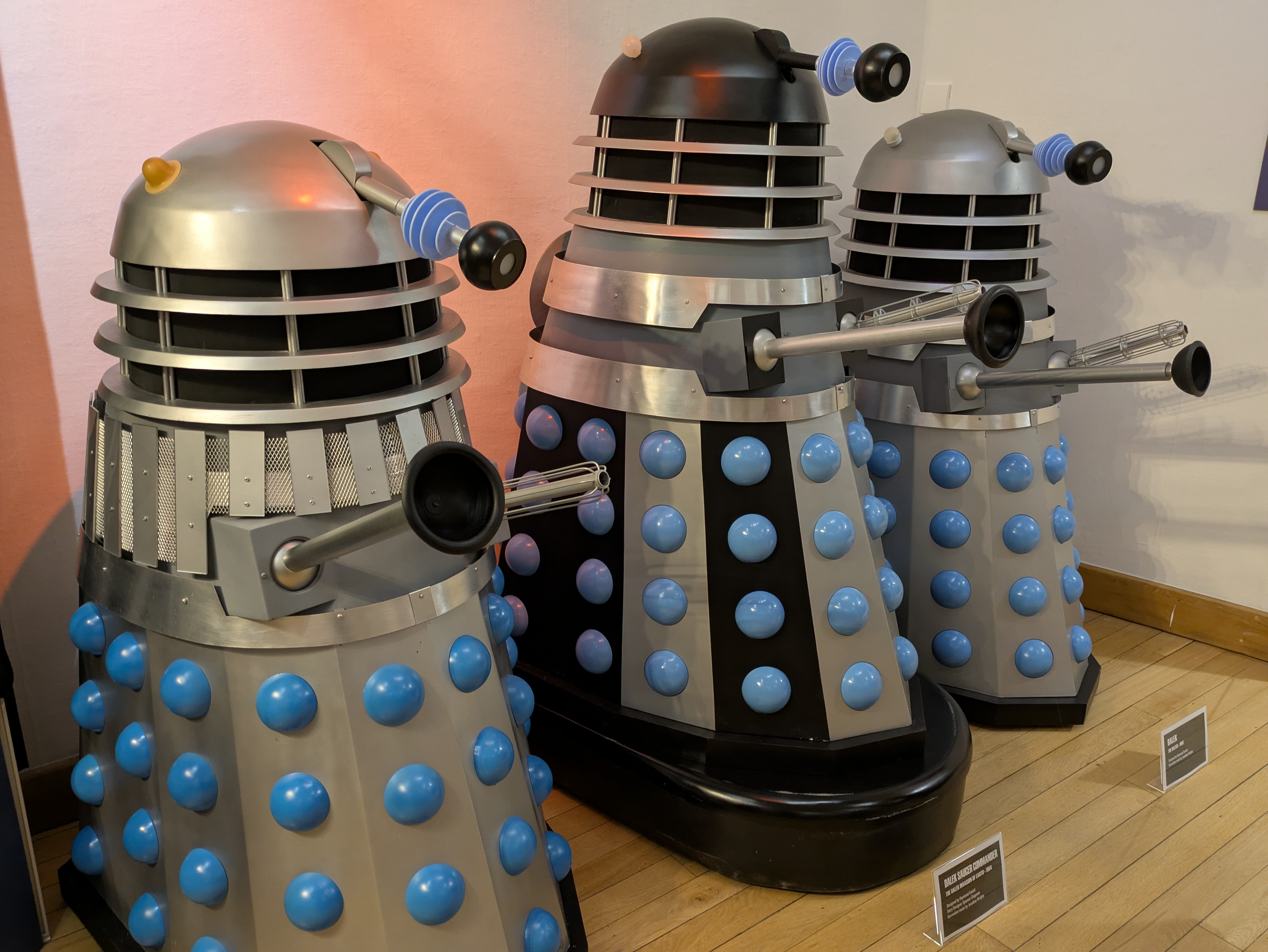
Daleks @ Peterborough


To be honest there are only a handful of Daleks from "Nu-Who" in the exhibition - a red New Paradigm one, the standard bronze model, and black Dalek Sec - so this latest post concentrates on the Daleks seen in the series 1963 - 1988, along with some related characters and models.
Just to give an idea of the layout, the exhibition sees you enter a room in which some Time Lords face the Silurian / Sea Devil group I showed you previously. They are lined up either side of a TARDIS console. Beyond this is the Cyberman section, with classic era models facing the newer ones.
You then move into another room in which there are lots of masks, models and costumes.
This then leads into a very big room, half of which contains Daleks, and the other half contains miscellaneous monsters from both eras of the programme.
Our first group of Daleks all made their debut in the Hartnell era - the city-based model seen in their very first story, the distinctive "Saucer Commander" from The Dalek Invasion of Earth, and then the standard Dalek with the vertical slats, which was first seen in the closing moments of The Space Museum, and ran through to a cameo in the final episode of The War Games.


Unusual to see that someone has made a Saucer Commander as it only features in a single episode, but I suppose the uniqueness was the attraction. I love the way they have included the little repair job to the middle ring beneath the dome. This ring got broken during the production of the story and they added a little piece of wood to act as a support, purely as a temporary measure. However, it was never replaced, and you will be able to spot this repair in various episodes throughout the 1960's. It was even included on the Eaglemoss figurine.
Before we move on to another unique Dalek, some models...


This little lot all come from The Daleks' Master Plan and represent the spacecraft of the alliance members, or Planetarians / Universal Council. The silver one, bottom left is the Dalek pursuit ship, whilst Mavic Chen's Spar 7-40 is third from left on top row.
That other unique Dalek is one of the highlights of the exhibition, and worth the £5 entry fee alone in my opinion...


It's a very impressive reproduction of the Emperor, from The Evil of the Daleks. It fills a whole corner of the room as they've provided it with a suitable backdrop, rather than just have it free-standing. As anyone who owns the Eaglemoss figurine knows, it simply doesn't look right in isolation.
the smaller lights surrounding the dome turn off and on in sequence.


Standing next to it is the first of our Dalek related characters - an Ogron, as first seen in Day of the Daleks, and then again in Frontier in Space.


For some reason these guys seem to be popular to recreate for fan-made video productions, and I'm afraid they don't always look that great. Here, I think they may have gone a bit overboard with the hairy arms... I think the problem here is also the fact that they've used a standard mannequin for display, so the head doesn't look bullish enough. For their TV appearances they sometimes had to split the masks at the back as the extras (often people overly familiar with the criminal justice system) were such big, bulky guys.
We next get a couple of 1970's Daleks, who flank the original version of Davros...


The Daleks either side of Davros are the silver / black model from Death to the Daleks, and the standard gunmetal grey version which first appeared in Day of the Daleks, and which also featured alongside their creator in Genesis of the Daleks. Two of my favourite colour schemes.


The final set of Daleks hail from the 1980's - from Resurrection and Revelation. We also get one of Lytton's troopers from the former story.


Next batch - some miscellaneous old skool monsters...

Thursday, 12 June 2025

P is for... Parry


Professor Parry was an archaeologist from Earth who mounted an expedition to find the tombs of the Cybermen on the planet Telos. This had become their home following the destruction of Mondas. After plaguing the galaxy, the Cybermen had vanished several hundred years ago, and it was believed they had died out. Parry wanted to find their city in order to study it. The expedition was being backed by a pair named Kaftan and Klieg, who had ulterior motives for financing it. Eric Klieg was a member of the Brotherhood of Logicians, who sought to establish a pact with the Cybermen. Also in the party were Kaftan's manservant Toberman, and fellow archaeologists Viner and Haydon.
They had travelled to Telos in a chartered spaceship, commanded by Captain Hopper.
Kaftan and Klieg had elected to fund Parry's expedition as they regarded him as disorganised and a little scatter-brained, despite his dedication - someone who would not have looked into their background too closely.
He was forced to watch as first Haydon then Viner were killed - the first accidentally by a Cyberman weapons test and the latter murdered by Klieg. He had wanted to scrap the expedition after the first death, but Hopper reported that their spaceship had been sabotaged so they would need to stay. 
He then discovered that the Cybermen were not extinct - merely dormant and awaiting revival.
Once the Cybermen had been defeated, Parry was the only surviving member of the expedition, returning home to Earth with Hopper and his crew.

Played by: Aubrey Richards. Appearances: The Tomb of the Cybermen (1967).
  • Richards (1920 - 2000) had a long career in British television. including roles in The Avengers, Dixon of Dock Green, Doomwatch and I, Claudius. He also featured in a number of Welsh dramas, including two versions of Under Milk Wood, 14 years apart.

P is for... Parks, Rosa


Rosa Parks was a seamstress from the town of Montgomery, Alabama, who in 1955 was targeted by a racist criminal from the future. Krasko intended to change history by ensuring that Rosa's protest against racial segregation on the town's bus services did not take place.  The subsequent bus boycott resulting from her arrest was a pivotal moment in the American Civil Rights movement.
The Doctor and her companions had to sabotage Krasko's efforts and ensure that history was allowed to run its course, without alerting Rosa to what was going on.
She numbered Martin Luther King among her friends.
By riding the bus on the fateful evening - 1st December - to ensure her safety, Graham O'Brien inadvertently helped trigger events. It was for him that Rosa was expected to give up her seat. On refusing to do so she was arrested, and history remained on track.

Played by: Vinette Robinson. Appearances: Rosa (2018)
  • Robinson had previously played doomed medic Abi Lerner in 2007's 42.
  • Parks (1913 - 2005) was given the Congressional Gold Medal by President Clinton in 1999 in recognition of her work in advancing the rights of black people in the USA. She had been active in the cause since 1943. After her arrest, she and her husband had found themselves unemployed and so moved to Detroit in 1957, where she remained active in civil rights and anti-apartheid work.
  • She has a railway station in Paris named after her, and the Doctor tells her companions that she has also given her name to an asteroid.

P is for... Parker, Henry


Henry Parker was a reclusive millionaire who collected objects of extra-terrestrial origins. Dying of heart failure, he was obsessed with one item in particular - the Pulse - as he felt that it was keeping him alive. When operated, it caused a massive radiation spike which was detected by the Torchwood team in Cardiff. Fearing an explosion they planned to break into his mansion and retrieve the source, which they suspected might be a weapon.
Amongst Parker's security arrangements were heat sensors, so Owen Harper was selected to infiltrate his home. Owen had recently been brought back to life by the Resurrection Glove and did not have any body heat.
The old man revealed to Parker that he knew a lot about Torchwood, as he had been keeping them under observation - whilst they had dismissed him as a harmless eccentric.
Owen was able to deactivate the Pulse before it could become dangerous, and Parker passed away. Owen believed that it had been his faith in the object which had actually sustained him, rather than any special properties it had.

Played by: Richard Briers. Appearances: TW 2.8: A Day in the Death (2008)
  • Briers had previously played the Chief Caretaker in Paradise Towers.
  • His wife Ann Davies had played Jenny in The Dalek Invasion of Earth.
  • Nephew of comic actor Terry-Thomas, Briers is best known for comedic performances - finding fame in the BBC sitcom The Good Life - though he had a late career in more dramatic roles thanks to Kenneth Branagh.

P is for... Paris


Paris was the middle son of Priam, King of Troy. He was a huge disappointment to his father, who thought him vain, cowardly and not a little dim. His judgement on these matters was sound. It was Paris who had run off with Helen, wife of Menelaus - the event which had triggered the decade-long siege of the city by the Greeks, who were commanded by Agamemnon.
Priam insisted that his second eldest go out and find Achilles and engage him in mortal combat, in revenge for his killing of Hector, his heir. Paris couldn't get out of this, but ensured that Achilles would not hear his challenge. He met instead the Greek warrior Diomede - really the Doctor's companion Steven. He was surprised when Steven surrendered so readily (he wished to be captured in order to rescue Vicki from Troy), and was easily flattered by him.
He also came across a gigantic wooden horse, which he assumed to be a parting gift from the Greeks, who had withdrawn overnight. He had it brought into the city, despite the protestations of his sister Cassandra, who was a prophetess.
That night Greek soldiers led by Odysseus - who was accompanied by the Doctor - emerged from the horse and opened the gates for the besieging army. Paris was killed by Odysseus, along with his father.

Played by: Barrie Ingham. Appearances: The Myth Makers (1965).
  • No proper photographs of Ingham as Paris are known to exist, so this piece is illustrated by an image from a Loose Cannon reconstruction of the story.
  • Ingham played the Thal Alydon in Dr Who and the Daleks.
  • He was also considered for the role of Arthur Terrall in The Evil of the Daleks.
  • In 1967 he played the title role in the film A Challenge For Robin Hood.
  • He spent the last years of his life in the US, having featured regularly in Broadway musicals, as well as appearing in TV series such as Murder She Wrote. Hart to Hart and The A-Team.
  • He also guest starred in an episode of Star Trek: The Next Generation ("Up The Long Ladder"), one of only a handful of actors to have appeared in both Doctor Who and Star Trek.
  • Priam is supposed to have had a lot more than 3 sons - 50 of them.
  • Homer presents Paris as cowardly and no great fighter. He also has him fire the arrow which kills Achilles, and he is mortally wounded by Philoctetes, rather than killed by Odysseus.

P is for... Panna


Elderly matriarch of the Kinda tribe of the planet Deva Loka. Blind, she was constantly attended by a young woman named Karuna. Only female Kinda had the power of speech. 
The Doctor met them both after encountering a party of humans who had come to assess the planet for colonisation. One of their number - Hindle - had suffered a mental breakdown and threatened to destroy their base, which would wipe out the whole area. The Doctor and a scientist named Todd escaped the base and met Karuna, who took them to a nearby cave to see Panna. The old woman was able to show them how the society here passed through a repeated cycle of destruction and rebirth, and this was about to happen again due to the re-emergence of an ancient evil force known as the Mara, which manifested itself in the form of a snake and could possess people.
The strain of showing them mental images was too much, and Panna died. However, her consciousness survived by passing into Karuna.

Played by: Mary Morris. Appearances: Kinda (1982)
  • Morris, who died in 1988, lived in Switzerland and drove from there to the UK to appear in the programme.
  • She played scientist Professor Madeleine Dawney in A For Andromeda and its sequel The Andromeda Breakthrough.
  • She also played the only female No.2 in The Prisoner - in the episode "Dance of the Dead".
  • Another appearance with Peter Davison, in his detective series Campion, was screened posthumously.

Tuesday, 10 June 2025

Inspirations: Time Heist


This one is relatively straightforward. The writer, Steve Thompson, thought that a bank robbery involving time travel might make for a good storyline, and Steven Moffat agreed. It transpired that he had been thinking along the same lines, but was just waiting to develop the idea.
The heist would be made more complicated by the fact that, as well as the usual forms of security, this bank would employ telepaths who could detect guilty thoughts as soon as you walked through the door - so anyone planning to rob the place would be spotted immediately before they even had a chance to carry out any crime.
The telepaths idea would become a specific creature - the Teller - which not only detected guilt but could do something nasty about it. Thompson specifically wanted a real physical effects creature as he knew from previous stories he'd written that CGI used up too much of the budget.

Films and TV series about bank robberies have been around since the media were created, and have featured in many genres of story-telling. It's such an adaptable plot structure. A lot of Westerns revolve around bank or train robberies, as do comedies, science fiction films, and even swashbucklers like the Robin Hood movies that would see elaborate plans made to steal from the rich.
Indeed, quite often the robbers have been the heroes of the movie, despite engaging in criminal activity. Generally, in these cases, the people being robbed are usually presented as deserving to be robbed - either because they're so rich they won't miss it, or because they are even bigger criminals than our gang.

Classic heist movies are too many to mention, but a few I'd recommend are the original Oceans 11 (1960), where it's a luxury liner that's being targeted; The League of Gentlemen (also 1960) in which the gang are all British ex-servicemen who have fallen on hard times since leaving the army; The Killing (1956), in which it's a race track that is to be robbed, or The Italian Job (1969).
In terms of comedies, you can't do better than the Ealing movies The Lavender Hill Mob (1951) and The Ladykillers (1955).
(Golden rule: always watch the originals, not the lacklustre remakes).
Often with these films, especially pre-1960's, it was felt that criminals shouldn't be seen to get away with it, no matter how personable they come across, so they can end up either with the heist going wrong or the gang members end up in handcuffs - assuming they don't wind up dead.
Another inspiration is the close cousin of the heist story - the con artist tale. The BBC TV series Hustle showed a loveable gang pull off seemingly impossible jobs - always against someone who thoroughly deserves it - and we have to wait to a flashback sequence at the end to see just how they managed it.

Time Heist has to see the Doctor and his gang commit their crime for a morally justifiable reason. They can't possibly be doing it for wealth, so it turns out to be a rescue mission - to save the Teller's mate as they're the last of their kind. Each of the gang members also has to be participating for some personal reason - Psi to get his memories back, Saibra to get a drug which will help with her condition.
In the initial drafts for the story, Saibra was going to be a half human / half Zygon, hence her ability to shape-shift.

The story is remembered for the cameo appearances of some old monsters, some of which are a little odd as choices. We know that the Sensorite society can produce wrong 'uns like the City Administrator, but you don't really think of them first when it comes to criminals. Weevils are savage creatures of pure instinct, so also not the obvious candidates for master criminals. Other characters include Captain John Hart, Androvax, a Terileptil, the Trickster, an Ice Warrior, Kahler-Tek and the Slitheen. It looks like they just picked a bunch of characters from random episodes across the parent series and its spin-offs, with no real thought as to their appropriateness. Oddest of all is Absalom Daak, who has only ever featured in comic book form - and he's a comic book character here as well. Couldn't they have got someone to dress up as him?

In order that the Doctor's gang can't be detected by the Teller, they employ Memory Worms to forget their ultimate intention. These were first introduced in The Snowmen.
Michelle Gomez was initially offered the role of Madame Karabraxos / Miss Delphox, but was unable to attend the audition, so asked Moffat to consider her for any other villainous roles...
Next time: First he gave you an episode in which the Doctor got a flat. Then he gave you a story in which the Doctor got a job. Now Gareth Roberts gives you a story in which the Doctor gets, er, a different job...

Sunday, 8 June 2025

Episode 164: The Evil of the Daleks (2)


Synopsis:
Kennedy is rifling through the contents of his employers' safe - unaware that a Dalek has materialised silently behind him...
He tries to run but the Dalek exterminates him. It moves back between the two large machines and dematerialises.
The Doctor had been asked to come to the shop at 10pm, but he has elected to bring Jamie there half an hour earlier. They find the front door open and enter. The Doctor is puzzled by some of the items on sale in the shop. They look to be genuine Victorian objects, and yet they don't appear to have any signs of age or wear.
One item even has its original receipt, so they are not reproductions.
Jamie thinks that Waterfield must have a time machine if he can possess objects which can be both brand new, and a century old.
Waterfield returns to his office to find the secret chamber open, and the Dalek has returned. He is horrified at the death of Kennedy and the callousness of the Dalek. It simply orders him to obey then vanishes again.
The Doctor and Jamie have heard voices, but before they can investigate someone else enters the shop. This proves to be the inquisitive Perry.
Waterfield tears the photograph of the Doctor in two and places half in a small wooden casket, which he leaves in front of the Dalek machinery. He then unlocks the office door and withdraws.
As the Doctor argues with Perry over the TARDIS, they see the office door open and find Kennedy's body, clutching part of the torn photograph. Perry tries to call the police but there is some strange interference on the line. He goes to fetch a policeman.
The Doctor is puzzled as to the cause of the electrical interference. He quickly realises from the length of the corridor and the position of the body that there is a hidden room beyond this one, and they search for a key - only to see the door open.
As they look around the inner chamber, Jamie spots the other half of the photograph sticking out of the casket.
The Doctor tries to warn him but is too late. Jamie opens the box, and they are both overcome by a noxious gas.
Waterfield re-enters the room and all three dematerialise, along with the Dalek machinery.
When Perry returns with a police officer, the shop is empty but for Kennedy's body.
At a large country mansion, a young woman is being held captive by the Daleks. They are monitoring her health, ordering her to eat and measuring her weight.
The Doctor wakes up in an armchair in the parlour of the house, where he is looked after by a maid named Mollie. He then meets Edward Waterfield as well as the owner of this house - Theodore Maxtible.
He explains that the date is June 2nd, 1866, and they are in his home which is located a few miles from Canterbury.
Jamie still sleeps from the effects of the gas, so the Doctor is taken to Maxtible's laboratory. There, the two men explain that they have been experimenting with time travel, building a cabinet full of highly polished mirrors which are charged with static electricity. The Doctor is automatically alarmed at the mention of static electricity. 
Maxtible and Waterfield explain that their experiments drew the attention of hideous inhuman creatures, which now hold them to ransom. They hold Waterfield's daughter, Victoria.
The Doctor's suspicions are confirmed when a Dalek emerges from their time cabinet.
Jamie has now woken up, and he meets Mollie and Ruth - Maxtible's daughter. He notices a portrait and learns that it is of Waterfield's late wife, but also closely resembles his daughter.
The Doctor is informed that the Daleks wish to conduct an experiment in order to identify the "Human Factor" - that set of skills and abilities which has led to their defeat so often in the past. The test subject is to be Jamie.
After Ruth has left, a man named Toby sneaks into the parlour from the garden, overpowering Mollie then knocking out and abducting Jamie.
The Doctor and Waterfield enter the parlour a few minutes later to find him gone.
Two Daleks have returned to the laboratory. They insist that the experiment begin immediately. 
Any delay will result in death...

Data:
Written by David Whitaker
Recorded: Saturday 20th May 1967 - Lime Grove Studio D
First broadcast: 5.50pm, Saturday 27th May 1967
Ratings: 7.5 million / AI 51
Visual Effects: Michealjohn Harris and Peter Day
Designer: Chris Thompson
Director: Derek Martinus
Additional cast: Marius Goring (Maxtible), Brigit Forsyth (Ruth), Jo Rowbottom (Mollie), Windsor Davies (Toby), Peter Hawkins (Dalek voices), Robert Jewell (Dalek)


Critique:
Episode Two of The Evil of the Daleks is the only surviving instalment of the story, so it's the one we know best. It sees the action move away from contemporary London and back in time to mid-Victorian Kent. A number of new characters will start to be introduced here, some of whom will prove to be superfluous to the plot unfortunately. We also get our first sighting of Victoria, who will go on to become a popular companion.
Deborah Watling was a member of a well-known British acting dynasty, daughter of Jack Watling who featured in many movies of the 1940's and '50's. She had been acting from an early age, including a regular role in the 1958 ITV series The Invisible Man, and had auditioned for the role of Polly the year before. Then, Innes Lloyd had thought her too young and not really fitting the 1960's 'dolly bird' image he had envisioned. A Radio Times cover depicting Watling as Alice in a 1965 BBC biographical drama about the life of Lewis Carroll reminded Gerry Davis of the actress when it came to this story.

After Pauline Collins had declined joining the series as the contemporary Samantha Briggs, the decision had now been made to turn a character from this story into the new female companion. The Victorian setting, and the fact that this was the name of one of Davis' own daughters, determined her name.
Watling wasn't the first actress offered the role. It was initially given to Denise Buckley, but negotiations with her and her agent fell through. 
Another candidate for Victoria was Jo Rowbottom, who was given the role of the maid Mollie Dawson instead.

Whitaker's original episode title was "The Net Tightens". Initial drafts also featured Waterfield's wife Ann. 
Tuesday 25th April saw two photographs being taken during the location filming at Grim's Dyke - the setting for Maxtible's home. One was a nocturnal image of the house for establishing shots, taken at 11.30pm. The other was a shot of Watling in costume, which would be used as the basis for the portrait of Victoria's mother seen in this episode. Designer Chris Thompson enlarged this then painted over it.
Two days of filming at Ealing Studios took place between the recording of episodes one and two, which covered the climactic battle in the final instalment. To ease pressure on Derek Martinus, these were directed by Timothy Combe, who had been working on the series since its first season and who would go on to direct two stories featuring Jon Pertwee as the Doctor.

The cast were now joined by Marius Goring, playing Theodore Maxtible. Martinus admitted that he was quite overawed by him, as he was famous for roles on the big screen as well as small. One movie he is particularly remembered for is Powell and Pressburger's A Matter of Life And Death, in which he plays the effete French aristocrat who is sent to fetch David Niven's RAF bomber pilot to the Afterlife, thanks to an administrative error. 
However, once the director saw how the actor threw himself into the role he was able to relax.
Patrick Troughton had featured in an episode of The Invisible Man, but not one in which Watling had appeared. He had worked several times with her father, however.
He and Hines took the young actress under their wing. Hines and she had already met during the location filming.
Watling was also looked after by Brigit Forsyth, who would go on to comedy fame as Thelma, wife of Bob Ferris in Whatever Happened To The Likely Lads?.
Interviewed in DWM  issue 212, Watling was mostly concerned about spots which broke out on her face on the day of recording her first episode.


In studio, Griffith Davies featured to enact his death scene, after which he was only called upon to play Kennedy's corpse.
Once again, dematerialisations in the hidden chamber were achieved by mixing from live action to a still image of the empty room - this time with the Dalek travel machinery also removed for when everyone leaves for the final time.
When the Doctor picks up half of the torn photograph, because of the complexity of the camera angles it would require, Troughton was recorded on the main set holding the photo, whilst another camera showed the close-up of the picture in his hand, actually being held by extra Barry Ashton on another part of the set.
Maxtible's parlour had french windows opening onto a garden, so sound effects were added to give the sense of the birdlife outside, as well as representing the "flying pests" which the Dalek accused Victoria of feeding.
Goring calls Waterfield "Whitefield" at one point.

The time-cabinet was given a specifically Victorian Gothic design, and had doors which hinged both ways so that the Dalek operators could enter or exit easily. It had a false back. The casket trap issued dry ice.
BBC visual effects also built the Dalek weighing machine, which featured flashing lights and an illuminated wall display.
As you can see from the rehearsal image above, the bedroom set was raised off floor level. Martinus had worked with Daleks before, on Mission to the Unknown, and knew their limitations, visually, so sought to shoot them from interesting angles.
Only one of the two Daleks seen in the closing sequence had an operator inside, the director taking care not to show that its dome lights did not flash with dialogue. The Dalek operated by Robert Jewell was a brand new prop provided by Shawcraft Models.
As mentioned last time, a continuity announcer had to read a statement about Terry Nation creating the Daleks over the closing credits, as it had been too late to amend the captions for this instalment.

Annoyingly, when it came to using a clip from this story to introduce the repeat screening at the end of The Wheel In Space, they elected to use one from this surviving episode - otherwise we might have had a nice clip from a missing instalment.
The film recording of this episode had been returned to the BBC in 1987, having been bought at a car boot sale by collector Gordon Hendry, along with the third instalment of The Faceless Ones.

In the same way that it's surprising that the first "quarry as alien planet" doesn't feature until The Savages, so it often surprises that the series doesn't visit the Victorian era properly until now. The First Doctor was always considered someone who would not look out of place in the late-Victorian period, and with its origins partly in 19th Century science fiction / fantasy literature this time zone would appear to be a natural fit for the series. As it is, the action will be confined to this one residential setting - the location for which just happened to have once been home to a very eminent Victorian - Sir William Gilbert, of Gilbert & Sullivan fame.
Famous Victorian scientists get name-checked - Michael Faraday (1791 - 1867) and James Clerk Maxwell (1831 - 1879). Unfortunately David Whitaker's grasp of science is not very good, and he muddles his facts about the pair. He has an obsession with static electricity, but doesn't understand its properties.
The Victorian obsessions with science and making money are both on show. Waterfield and Maxtible are amateur scientists, and Maxtible states that he has the money to indulge their interests.
We have to ask why Maxtible has a portrait of Waterfield's wife in his home, and the suggestion is that both Edward and Victoria also live here. It has been suggested that Maxtible was responsible for ruining his friend, and so took them in by way of recompense. (Hardly out of charity - it's not in his nature - but perhaps in order to have some hold over him, perhaps exploiting his technical skills).
We will later discover that his current wealth isn't enough. Like the writer, he has an added obsession about alchemy - the ancient lure of transmuting base metals into gold.

One other question we do have to ask: if the Daleks have time machines, why visit 1866 in the first place? Why not simply set up a base of their own in 1966 to ensnare the Doctor?
And was it really WOTAN which the Doctor sensed when he arrived in Fitzroy Square? He did say that he got the feeling when Daleks were about - and we've now discovered that they were active in Chelsea at the exact same time. It's a massive coincidence that two lots of aliens and a home-grown menace should all strike the London region at the same time. Could one of these other incidents have been set up by the Daleks as a means to trap the Doctor? The Chameleons are the obvious ones, as how else could the Daleks know that the TARDIS would be found, unattended, at Gatwick Airport for them to steal?

Trivia:
  • The ratings see a drop of more than half a million on the opening instalment.
  • Opposition on ITV included talent show Opportunity Knocks! in the London region, Lost In Space and Bonanza.
  • The episode was repeated at 5.15pm on Saturday 15th June 1968, when it was watched by 5 million viewers, and had an appreciation index of 52 - marginally higher than the original broadcast. 
  • Television Today highlighted the debut of Deborah Watling in the series on 29th May, featuring a publicity photo of the actress in costume at the Grim's Dyke location. At no point is Victoria ever seen in the grounds of the house in the programme. Nor does she ever take tea with Ruth, as another publicity image showed.
  • Another actor considered for the role of Maxtible was Patrick Wymark. Best known nowadays for Where Eagles Dare, Witchfinder General and The Blood on Satan's Claw, he was the star of The Plane Makers (1963 - 65), which morphed into The Power Game (1965 - 69). Wymark played the anti-hero John Wilder in both series. Lloyd had wanted to work with him for some time, and even considered him as a replacement for William Hartnell as the Doctor.
  • Losing out to Windsor Davies, who will become famous for comedy roles in numerous films and the army concert party sitcom It Ain't Half Hot Mum, was actor Christopher Benjamin (Inferno, The Talons of Weng-Chiang and The Unicorn and the Wasp).
  • Frazer Hines once claimed that he was sitting inside a Dalek casing one day during a break in recording, and overheard a couple of guest stars criticising the show - unaware that the prop was occupied. As this is Hines' only Dalek story, we can only assume that he was referring to a pair of these guest artists. He did not say who they were, however. Goring is reported to have thoroughly enjoyed his time on the story, whilst John Bailey had been in the series before (as the commander in The Sensorites) and would appear again a decade later (as Sezom in The Horns of Nimon). Saying that, Colin Douglas, after appearing in The Enemy of the World, had claimed he would never do another Doctor Who as he felt the programme beneath him - only to turn up later in The Horror of Fang Rock.
  • On the Wednesday following broadcast, at the BBC weekly programme review meeting, Huw Weldon was disappointed to learn that this might be the last ever story to feature the Daleks.