Sunday, 10 May 2015

Series 9 - looking ahead...


We're about at the 6 month's mark before the next series of Doctor Who begins, and the production team is about half way through making it as well, so let's see what we know so far about Season 9.
Two parters are back big time - including the season opener. This sees the return of Michelle Gomez as the Missy / Master. It was at least partly filmed on Lanzarote - seemingly playing itself once more. A new alien was revealed - a blue faced, red eyed humanoid. Need not necessarily be a significant character of course. Episode titles are The Magician's Apprentice and The Witch's Familiar. Both titles could refer to Clara, should she fall under Missy's spell.
As season opener, the writer is naturally show-runner Steven Moffat. This is one of at least two stories to feature UNIT's Kate Stewart (Jemma Redgrave). Claire Higgins, who played Ohila in Night of the Doctor also appears. Lanzarote once played Sarn - might it also now play Karn?
Probably not... Just put that in for the rhyme.

Episodes three and four are also a two parter - written by Toby Whithouse. This is the one supposed to be set around an army base - possibly a Russian one. Paul Kaye is the main guest star, along with Colin McFarlane, who appeared in TW: Children of Earth.


And episodes five and six seem to be yet another two parter - certainly having the linked titles of The Girl Who Died and The Woman Who Lived. Again - does this refer to Clara, or might it be young Maisie Williams from Game of Thrones who is one of the main guest artists?
This is the one that was filmed at the Iron Age village reconstruction and has actor David Schofield appearing as someone called Odin - so expect Viking-esque goings-on. These massive robotic creatures were unveiled as a new monster for these episodes. The writer is Jamie Mathieson, who gave us a couple of cracking stories last year. Other guests include Struan Rodger (voice of the Face of Boe), Rufus Hound and Tom Stourton of Horrible Histories.


And so we reach episodes seven and eight - and it seems this is yet another two parter. This is the other story which features Kate Stewart of UNIT and, despite having being quite cruelly killed at the end of last season, we are also going to see the return of Osgood (Ingrid Oliver). Seems the Zygons are back as well - so the obvious thought is that it is the Zygon-Osgood we will be seeing. However, this would contradict Terror of the Zygons where the original had to be alive for the Zygon to copy the body-print. Moffat has either thrown this notion out, or this may be Osgood in flashback, to events immediately after Day of the Doctor. These might just possibly be UNIT heavy / Doctor lite episodes.
The writer is Kill The Moon's Peter Harness.

The only other things we know about Series 9 at this stage are that Moffat is going to explicitly address the fact that the Twelfth Doctor looks not unlike Caecillius from The Fires of Pompeii. He stated as much in the most recent issue of DWM. Also, that Mark Gatiss has written a story. Another two-parter? Remember, more stories are commissioned for each series than are actually filmed, so we still have to get confirmation that his will be made - but it is pretty obvious it will be. Assuming Moffat is also writing twelve and thirteen, only three episodes are left unaccounted for.
Is this finally the start of a rest period for the Daleks as well?

Saturday, 9 May 2015

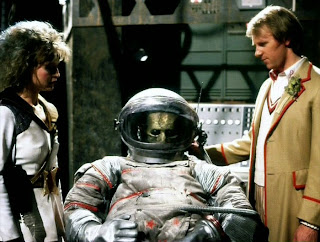
Story 126 - Terminus


In which Turlough continues to plot the Doctor's destruction, still acting on the orders of the Black Guardian. He is instructed to sabotage the TARDIS - the Guardian telling him that he will be pulled to safety once his work is done. The outer shell of the ship is compromised by his actions. Nyssa becomes trapped alone in her bedroom as the walls begin to dissolve. The ship has a defence mechanism whereby, in the event of imminent break up, it latches onto the hull of the nearest spacecraft. The Doctor, Tegan and Turlough watch on the scanner as a door appears in Nyssa's room with a macabre skull motif on it, and the Doctor urges her to go through it. They follow shortly after her - and find themselves trapped on what appears to be a deserted spaceship. They must find a way to open the door back through to the TARDIS. Soon after, another ship docks with the craft and two pirates come aboard - Kari and Olvir. They find the Doctor and Nyssa on the flight deck, where the Doctor has found that the ship is on automatic pilot and headed for a location which appears to be at the very centre of the known universe. The pirate vessel suddenly breaks away and flies off. Kari says that their captain told them this was a luxury liner, but Olvir knows what it really is. They are headed for Terminus - a massive space station. The only people who go there are Lazars - people who carry a deadly contagious disease. They are supposed to be cured on Terminus, but no-one has ever been known to return. Olvir knows this as his sister was taken there. As the ship docks with the space station, hundreds of doors open up and the Lazar "passengers" begin to emerge.


Tegan and Turlough take refuge in the under-floor maintenance ducts. Nyssa becomes separated from the Doctor, and Olvir abandons her when he sees that she has the early symptoms of the disease. She finds herself caught up in the crowd of Lazars and is swept into the station. Terminus is run by a company which uses slave labour to man it. They are the Vanir. Their loyalty is bought through an addiction they have to a substance called Hydromel, which the company supplies to them in return for their work. The Vanir wear protective armour to combat high radiation levels at the heart of the station. It is to this part of Terminus that the Lazars are taken - left to be collected by a huge bipedal canine creature called the Garm. As she is not as ill as most of the others, Nyssa is taken to the Garm. Regretting his earlier cowardice, Olvir goes after her. He encounters one of the Vanir named Valgard and from him learns that his pirate captain often offers up some of his crew to the company to become new Vanir - the fate intended for Kari and Olvir. The same thing had happened to Valgard many years ago. The Doctor and Kari also venture into the radioactive zone and come upon the control room. Here they find the mummified remains of the station's original pilot - a gigantic humanoid. The Doctor discovers that Terminus once had time travel capability. The engines are damaged and unstable. The Doctor realises the significance of the station's location at the very heart of the universe. The pilot had travelled back in time and jettisoned fuel which then combusted primordial gasses. This was the event which caused the creation of the universe. At the last moment, Terminus had been thrown forward in time. The Black Guardian instructs Turlough to carry out some sabotage - this time on the Lazar ship which is connected to the station. His actions cause the station's engines to begin to fail.


The Doctor realises that the original engine failure created the universe, but this time it could destroy it. He and Kari aren't strong enough to operate the ship's controls, but realise that the Garm could do it. It cannot act independently, however, being forced to follow the orders of the Vanir through a control box. The Doctor steals this and uses it to bring the Garm to the control room. The creature is as much a slave as the Vanir. The Doctor offers to free it if it stops the engines. In return, he smashes the control box and releases it. Nyssa reveals that Terminus could be made to work if operated properly. She has been cured by the radiation. Also, the Hydromel can be synthesised easily so that the Vanir would no longer be dependent on the company. She elects to remain behind on Terminus to work with the Vanir, now commanded by Valgard after overthrowing their hated leader Eirak. The Garm will also stay on to work willingly with them to help cure the Lazars.
The TARDIS systems have now repaired the damage caused by Turlough's sabotage. The Black Guardian informs the treacherous schoolboy that he has one last chance to destroy the Doctor - otherwise he will be destroyed himself...


This four part adventure was written by Stephen Gallagher, and was broadcast between 15th and 23rd February, 1983. It forms the middle story of the Black Guardian Trilogy, and is significant for seeing the departure of popular companion Nyssa, played by Sarah Sutton.
This was Gallagher's second - and final - script for the series (the first being Warrior's Gate in Season 18). Once again, he was not very happy with the story as it finally turned out, and like his earlier serial there were significant production problems. This time it was mainly due to the industrial action that would eventually see the postponement of the planned season finale.
Some 25 scenes had not been filmed, and these had to be remounted in December 1982 whilst The King's Demons was being recorded. In order to finish this story, the Dalek adventure "Warhead" had to be sacrificed. Luckily Sarah Sutton still had a day to run on her contract, though it meant her having to come back after she had already had her leaving party - which was a somewhat subdued affair as the director Mary Ridge had fallen out with producer JNT over the failure to complete the story as originally planned.
Gallagher's initial idea had been some sort of mechanism from another universe which found its way into this one and actually helped create it. The Vanir came from Norse myths, and so they all ended up with suitably Scandinavian names - Valgard, Sigurd, Eirak and Bors.
The Lazar disease is obviously inspired by leprosy.
Gallagher was particularly unhappy with the on screen realisation of the Garm. He had simply described it as a wolf-like creature, its eyes glowing in the shadows of the radioactive Forbidden Zone. What we got was one of the least favoured creature designs - a big pot-bellied dog-headed thing with an unrealistic mask.


The casting goes from the sublime to the ridiculous. One-time Mrs. Colin Baker Lisa Goddard simply does not convince as a battle-hardened space pirate. She and Dominic Guard (as Olvir) are saddled with truly dreadful costumes as well. Amongst the Vanir, however, are two marvellous performances from Andrew Burt as Valgard, and Peter Benson as Bors.
Nyssa, rather notoriously, gets all hot and bothered and decides to strip down to her undergarments - something definitely put in to "please the dads" watching.
Despite this being Turlough's trilogy as much as the Black Guardian's, there really isn't any room for Mark Strickson's character in the story - so he and Janet Fielding spend most of it stuck in air ducts.
Episode endings are:
  1. As the Lazars spill out of their rooms into the corridors of the spaceship, Olvir cries out that this is a leper ship, and they are all going to die...
  2. Valgard attacks the Doctor, throttling him...
  3. Thanks to Turlough's latest sabotage, Terminus' engines now threaten to destroy the entire universe...
  4. Turlough is given an ultimatum by the Black Guardian - destroy the Doctor, or else...

Overall, quite a good adult story let down by a couple of performances and a poor creature design. 
Things you might like to know:
  • The voice heard on the tannoy system is the same bloke who used to warn London tube passengers to "Mind the Gap" - until replaced by a female voice.
  • A fan visiting the recording caught sight of the Vanir armour and was convinced that this story saw the return of the Ice Warriors. Naturally, he "spoiled" and a few fanzines picked this false rumour up.
  • Despite the TARDIS being of immense size, Turlough gets given Adric's old bedroom - so we get to see a number of props from the previous season.
  • To tie in with continuity to Arc of Infinity, the component beneath the TARDIS console which Turlough attempts to remove is called the Space-Time Element.
  • A number of the TARDIS sequences in Part One were added when this episode was found to be under-running.
  • The fight arranger on this story was John Waller - brought in because he was an expert in medieval fighting practices, as the Vanir used staves. Had they used swords, Waller wouldn't have been needed, as Mark Strickson was a qualified fight arranger in his own right. Doing his own stunts was part of his contract, though he wasn't at all happy at the scraped knees he got when stuck for most of the story in the air ducts.
  • Sarah Sutton wasn't the only TARDIS regular who exposed a bit more flesh than usual, as Janet Fielding famously "popped out" of her bustier during recording - as oft-told on the convention circuit.
  • Kari and Olvir's costumes were supposed to be be blue, but had to be changed to white due to the use of blue-screen CSO.
  • Kari's character was originally going to be called Yoni. This was changed when script editor Eric Saward worked out where this came from. I'll leave you to Google it for yourselves...
  • Whilst Sarah Sutton / Nyssa has never returned to the TV series, her character has been a mainstay of the Big Finish audios - first accompanying the Fifth Doctor in some stories set between Time-Flight and Arc of Infinity, then as a much older version of the character who rejoins the TARDIS crew after her on-screen departure. She has a son called Adric. As for Sarah Sutton herself, she pretty much gave up acting. She had been unhappy at having acted since childhood - without having a proper childhood herself - and regretted never having gone to drama school.

Tuesday, 5 May 2015

TARDIS Travels No.23


Apologies if you were looking for "Story 126 - Terminus" this evening, but that will be later in the week. Season 23 also saw some significant changes in what was planned for the TARDIS. No visits to Blackpool, Singapore or the planet Magnus. Instead, what we got was the Trial of a Time Lord - with the TARDIS being seen to be pulled towards a massive space station in the opening moments of Part One.


Journey 359: Necros, date unknown, to Ravalox, 2 million years in the future.
We don't actually get to see the TARDIS at all in this story proper - though its arrival in the forest is to be seen in an untransmitted scene on the DVD. Ravalox has the same mass, tilt and period of rotation as the Earth - as well as a Marble Arch Tube station. That's because this is the Earth - moved across space by the corrupt High Council of Time Lords, as we will subsequently learn.


Journey 360: Ravalox / Earth, 2 million years in the future, to Thoros Beta, 2379.
An unseen journey prior to this, as the Doctor is already investigating how high-tech weapons got into the hands of some warlords on Thordon. The ship rather inconveniently materialises in the sea some yards from the beach.
The Time Lords in the court have the ship moved to within the Mentors' base, for this is the point that the Doctor gets abducted to face his Inquiry - before he can save Peri. All part of an elaborate assassination plan to stop the scientist Crozier's work without directly interfering themselves.


Journey 361: Thoros Beta, 2379, to Gallifreyan Space Station, date unknown.
This is where we came in - the TARDIS, with the Doctor aboard, is taken to the station for his court appearance. The process gives him amnesia.
Things get a bit confusing from this point on as, technically, the next TARDIS journey we see is the landing on the space-liner Hyperion 3. However, that is seen in a Matrix extract from the Doctor's future - so the next time the TARDIS actually moves in the Doctor's time-line is when it leaves the station after the Valeyard has been defeated.


Journey 362: Location and date unknown, to Hyperion 3 space-liner, 2986.
Once the TARDIS does leave the Time Lord space station, there are obviously a number of unseen journeys before the Doctor intercepts the message from the Investigator, Hallet, that brings him to the luxury liner which is en route from Mogar to Earth. He has to meet Mel properly for the first time, of course - unless their time-lines have been altered and she simply travels on with him from the space station until her departure on Iceworld. How can the Doctor experience Terror of the Vervoids twice - and have no recollection of having seen it all before? (Experiencing it once was bad enough for us viewers...). And whilst I'm at it, if this story was from the Doctor's future  - so hadn't happened yet - how could he be accused of genocide? When he hadn't done it yet? I suspect the Time Lords later do something to change this particular set of events.
The ship materialises in the Hyperion's hold. Quite how Hallet got a message to a time machine is never explained. Was he given a Space-Time Telegraph like the one left with the Brigadier, or are the telepathic circuits at play once more - the ship arriving in the right time and general region of space so that the Doctor could pick up the message?

And that's it for Season 23 - and for the Sixth Doctor. Only four stories long, as it will be until the end of the Classic Era of the programme.

History blog updated tonight


http://historywithoutatardis.blogspot.co.uk/2015/05/cross-bones-graveyard-and-winchester.html

A little Doctor Who connection in my latest history blog post.
By the way, tomorrow night should see my look at Terminus on this blog.

Monday, 4 May 2015

May The Fourth Be With You...


Happy Star Wars Day everyone...

Know Your Cybermen: Cyberships


The very first Cyberships seen on screen, in The Tenth Planet, were small, squat circular craft. Each held only a small number of Cybermen. We saw little of the interior save for the area where first Polly and then the Doctor were confined. It is significant that the Cybermen had special chairs designed for humanoid captives. These ships were useful for flitting between Mondas and the Earth like shuttles, but did not look as though they could manage interstellar travel.


The second ships we saw, in The Moonbase, were your traditional flying saucer shape. These were not very large either, but were obviously capable of intergalactic flight. Again, we did not get to see very much of the interior - save for the control console area. The significance of the strange lighting effects is not known. These Cyberships were sent hurtling from the Moon by the Gravitron, but presumably once beyond its influence their propulsion units would have overridden its effect.


The first massive Cybership appears in The Wheel In Space. We don't get any real sense of scale. It is long, with a large antenna on the top. The Doctor surmises that it contains their invasion force - and the Cyberman he's talking to does not contradict him. Like most alien spaceships at this time in the programme, the ship relies on a homing beacon to get to where it wants to go. It is easily destroyed by the Wheel's X-Ray laser - suggesting it does not have much in the way of defences - though the laser was boosted by the TARDIS Time Vector Generator. The interior was never seen.


The Invasion sees the first appearance of what is now regarded as the classic Cyberman spaceship design. Far from streamlined, it has wheel shaped sections at front and back, with a globe structure in between. There is a whole fleet of these ships. Once again, they do not appear to have much in the way of defence. Conventional missiles destroy them. No sight of the interior. If you pay close attention to the UNIT lab in Spearhead From Space, you will see one of these model props reused as a piece of scientific equipment.


There is a new smaller craft on view in Revenge of the Cybermen. Despite Earth having fought a war with the Cybermen, the human crew of Nerva Beacon do not recognise the design - so it may be a stolen ship not necessarily built by the Cybermen. There are missile tubes in the nose. The interior of the command deck is seen and it is, as expected of Cybermen, purely functional. This craft is destroyed by the Vogan Skystriker rocket.


We do not see another Cybership until Silver Nemesis - where there are two designs on show. The first is a small shuttle craft, containing only a dozen or so Cybermen. This is destroyed by a brace of Ace's Nitro-9 explosives.


Later, we see the main Cyber-fleet. These ships owe a little of their design to The Invasion ones - in that they are larger at the front and back and narrow in the middle. These craft appear to have some kind of cloaking capability. The entire fleet is wiped out by the Gallifreyan Nemesis statue.


The first Cybership of the New Series, in The Next Doctor, is a Dreadnought-class craft known as a Cyber-King. It is shaped like a massive Cyberman, and contains a conversion factory. We see it walking, but presumably these can also fly. This particular one was built in the Victorian era using the available technology of the time, so presumably these Dreadnoughts are usually much more high tech and streamlined.


The Matt Smith era of the programme sees the return of The Invasion design for the Cyberships - as seen in The Pandorica Opens and A Good Man Goes To War. These have the wheels at front and rear, with the globe in the centre, but each has a long cylindrical section at the very front.


There is another Cybership on view in Closing Time, but we don't get a clear look at the overall design as it is mostly buried. It is unlikely to be one of the large "wheel and globe" ones - perhaps a large shuttle or even an escape craft from one of the bigger ships.


2013 saw a major redesign for the Cybermen - and a new spaceship to go with this. In The Time of the Doctor, even the Doctor and the TARDIS fail to recognise it. It is a spiky, six-winged design. We see the interior, and the new  Cybermen are seen to stand in individual cubicles when inactive. The hemisphere designs throughout are based on the foot and hand holds as seen in the Cyber-tombs on Telos.

Sunday, 3 May 2015

The TARDIS Has Gone Green...


Back again. Did ye miss me? Nah? Well stuff ye...
Whilst I was in Glasgow, I came across a number of the city's many TARDISes - of which there are quite a few, These ones are all in the city centre. The first one I came across was up on the High Street near Glasgow Cathedral (below).


That's the Cathedral in the background (which I will be talking about in my history blog shortly). Naturally, whenever anyone sees one of these Police Boxes, they call them "TARDISes" - though not necessarily with Capital Letters....
As I stopped to take this picture, there were several other people doing the same, and the words "Police" and "Box" were rarely mentioned. They were being referred to as "TARDISes" throughout - especially if kids were present.
Later on I moved over to Buchanan Street - which is where I took the pic at the top of this post. Probably Glasgow's most famous TARDIS, as it is most central. If you have been following me on the Book of the Face, you will have seen my horror at what happened to it this morning. Yes, it went green. Or Green.


Now I don't know if this is simply the undercoat, or if this particular TARDIS is coming out for the Green Party (there is an election in the UK in a few day's time), or if a crowd of rampaging Celtic fans - fed up with the TARDIS always being blue - came along... All I know is the TARDIS in Buchanan Street is now, as of this morning, lime green...
But that wasn't the half of it. As I walked up to the coach station, I passed the eastern end of Sauchiehall Street - Glasgow's most famous thoroughfare. And there was another TARDIS.
And this one was bright red...


I love the fact that you can still see real Police Boxes in Glasgow, and that the average passer-by refers to them as TARDISes, but this multi-colour thing I am not so sure about.
PS: One thing to note about real Police Boxes - no lamps on top. Sirens.