Wednesday, 6 December 2023

What's Wrong With... The Pirate Planet


Douglas Adams had been submitting stories to the programme for a while before Anthony Read decided to take a gamble.
One of the problems Read's predecessor had encountered was the complexity of Adams' ideas. In many ways they were similar to the first efforts of the Bristol Boys, Baker and Martin, who initially showed a lack of discipline in their writing. Their imaginations did not necessarily align with what was achievable - and affordable - on TV.
Even with Read's guidance, as soon as Graham Williams' boss saw this he demanded that it be scrapped. He particularly disliked the humour and told the producer that Tom Baker would fail to take this seriously and play it for laughs - something which they were trying to reign in.
It was only because there were no replacement scripts at an advanced enough stage that Williams and Read were allowed to continue.
In many ways it's a miracle that Adams was recruited to replace Read only a short time later (though the success of a certain comic sci-fi radio show may have swung the decision).

Unlike Robert Holmes in the previous story, whilst the segment does have a role to play, the Key to Time isn't well integrated into the story.
The Doctor claims that Zanak will be fine in its new permanent location. However, its has been stripped of all of its minerals, and its hollow centre is now filled with the remnants of Callufrax, which have also been entirely drained of mineral resources. Hopefully there's a planet nearby to trade with (and a product someone wants to buy) - except the Captain has suppressed the technology to get them into space, and they don't even know what stars are, let alone how to get there.
Callufrax was described as an icy planetoid - meaning that Zanak's new location must be pretty far from its sun (and yet there's no sign of this throughout the story. We see a bright blue sky and no-one is wrapped up for a wintery climate).

Adams was unhappy with some of the casting, including the Captain.
Some of the performances are a trifle wooden - e.g. "Why? Why? Why, Why? Why?".
There are also some dodgy melodramatic lines - "Bandraginus Five, by every last breath in my body, you'll be avenged".
The trouble with Technobabble is that it is very easy to trip over, verbally. Tom has a couple of fluffs here:
K-9 talks about a power level of 5347.2 on the vantalla cycle scale - to which Tom responds: "543.72?" - and K-9 agrees.
We also have the psychic wavelength of the Mentiads being 338.79 micropars one minute, and 337.98 the next.
There are a couple of gun-fights which depict Kimus and Romana as crack shots. Much has been made of her sheltered background in Time Lord academia, and I can't see anyone outside the Bridge guards being allowed anywhere near a weapon - so where did these marksman skills come from?
Why does the Doctor risk trying to lure the guard away from the aircar in the exact same manner he used before, when he could just have gotten K-9 to stun him?
(And his jelly babies are clearly Liquorice Allsorts).

Tuesday, 5 December 2023

Doctor Who Covers - RT and DWM


The latest issue of DWM is out on Thursday. On the same day Radio Times previews The Church on Ruby Road, and features Ncuti on the cover (likely a different image for non- subscribers).
RT has for a number of years covered the festive episode in the final issue before the double one which covers Christmas itself, usually with a Doctor Who cover.
DWM will also be previewing the Christmas Special as well as The Giggle, and reviewing the first two anniversary episodes with behind the scenes features. There's a piece on Bernard Cribbins and the "Fact of Fiction" looks at Hell Bent. We're also promised a Christmas quiz.

Inspirations: Amy's Choice


Technically, this story takes place entirely within the TARDIS. It just doesn't look like it due to the Leadworth dream.
It's only the second episode to have the companion's name in the title - the first being Rose.

One of the things Steven Moffat did on becoming showrunner was to invite submissions from writers who were better known for comedy / comedy-drama work. The author of this story is Simon Nye, who is best known for the popular sitcom Men Behaving Badly, which ran from 1992 - 1998. It was produced by Moffat's mother-in-law, Beryl Vertue.
The idea for a story involving split dreams came from Moffat, but Nye wanted to write an episode which would concentrate on the relationship between Amy and the Doctor / Rory when under stress.
In discussions with Moffat, Nye had told him that on first waking after particularly vivid dreams, was he momentarily confused as to whether he was still sleeping or awake.
Having one dream set five years in the future allowed for some humour. Having Amy pregnant was introduced purely to play around with the cliché that the Doctor and companions are always running.

When asked to include a monster, he came up with the idea of a creature centred around an old peoples' home. 
Nye claimed that young people often found old people somewhat scary - but hoped he wouldn't put small children off visiting their grandparents.
The home is called "Sarn", which just happens to be the name of the world in Planet of Fire.
The Eknodines were designed to be cheap and easy to realise.
Mr Nainby (stunt performer Nick Hobbs, who played Aggedor) was named after a school friend of Nye's.

The Dream Lord calls the Doctor "the oncoming storm", which is supposed to be what the Daleks call him - first mentioned in the novel Love and War, but stated on screen in Parting of the Ways.
He also refers to him as a vegetarian. The Doctor had adopted a meat-free diet after the events of The Two Doctors.
The running joke about his relationship with Queen Elizabeth I is also mentioned - which originated in The Shakespeare Code.
The Dream Lord is a manifestation of the darker side of the Doctor's nature - originating from his subconscious.
We'd previously seen an embodiment of this in the Valeyard - an incarnation from between his twelfth and final one. (The extension of his regeneration cycle in The Time of the Doctor, and then the introduction of the Timeless Child have further muddied this already opaque concept).
Even earlier, in The Time Monster, the Doctor had told Jo to ignore his subconscious thoughts as relayed by the TARDIS telepathic circuits, claiming that there were some he was not very proud of.

Moffat has big plans for Rory, usually involving him dying (as happens for the first time here - though only within a dream).
After her attempted seduction of the Doctor,  this episode served to make Amy realise just how much she really loved her fiancĂ©.
At one point the Doctor thinks the TARDIS has jumped a time-track - a reference to The Space Museum.
This is the first story of the 5th Series not to feature the crack in time.
Next time: The Pertwee era revisited...

Sunday, 3 December 2023

Episode 94: The Traitors


NB: This episode no longer exists in the archives, nor is there a full set of telesnaps. Representative images are therefore used to illustrate it.

Synopsis:
As Katarina goes to check on the airlock door she is seized by the convict Kirksen, who drags her inside and seals them both in...
The desperate man insists that they change course. He cannot go to Earth, and demands to be taken to Kembel instead. Bret argues that they cannot jeopardise their mission for the sake of a single individual, whilst Steven insists they do everything in their power to free Katarina. The Doctor is forced to agree that they should change course for Kembel - though only to give them time to work out some other plan.
Realising that the fate of millions depends upon the success of the Doctor's mission, and recalling the prophecy of her imminent death, the young Trojan elects to open the outer airlock door.
She and Kirksen are sucked out into space...
Steven and Bret are horrified at what has just happened, but the Doctor has them focus on their mission. Katarina has sacrificed herself so that they might have a better chance of success, so they must not let her death be in vain.
On Kembel, the Dalek pursuit ship has reported its failure on Desperus. Despite being in a position to resume its chase, the Supreme orders that the vessel be destroyed. Failure is not to be tolerated.
Trantis begins to openly criticise the Daleks for putting so much trust in Mavic Chen.
He, meanwhile, is back on Earth and is working with his deputy Karlton to identify the agents who have interfered with their plans - for Karlton is fully involved in his superior's treason.
He dismisses his deputy's claims that Trantis will be made the chief ally of the Daleks. It is a role he plans to assume himself.
Chen is unhappy that his underling failed to stop the investigations by first Marc Cory and then Vyon and Gantry. He insists that the occupants of the Spar be killed immediately on landing.
All agents have been recalled, and Chen approves of Karlton's decision to place agent Kingdom in charge of the operation.
The Spar approaches Earth, and Bret informs the others that he plans to make for a scientific research centre well away from the main landing area, where a friend named Daxtar is based. He should be able to help them.
Chen sends an update to the Supreme, adding the deliberate disinformation that Bret's allies have been identified as coming from Trantis' galaxy.
Daxtar is at first difficult to convince of Chen's treason with the Daleks, but then he offers to assist them. The Doctor suddenly accuses him of being part of the conspiracy. he had mentioned the Taranium Core, when no-one had said anything about it containing that mineral. Realising that his friend is another traitor, he shoots him dead.
The Spar was damaged on landing so they cannot return to it, but Space Security agents are closing in. Kingdom and colleague Borkar force the chief scientist to accept their fellow agents taking over the complex.
The Doctor and Steven run deeper into the research centre whilst Bret holds back to win them time to escape, hoping to convince his fellow agents that they are being manipulated.
He is pleased to see Kingdom - Sara Kingdom - but she guns him down.
She orders that the other two criminals are to be shot dead - coldly advising her colleague to aim for the head...
Next Episode: Counter Plot


Data:
Written by: Terry Nation
Recorded: Friday 12th November 1965 - Television Studio TC3
First broadcast: 5:50pm, Saturday 4th December 1965
Ratings: 9.5 million / AI 51
Designer: Barry Newbery
Director: Douglas Camfield
Additional cast: Jean Marsh (Sara Kingdom), Maurice Browning (Karlton), Roger Avon (Daxtar), James Hall (Borkar).


Critique:
For Adrienne Hill, her first work on Doctor Who was to attend Ealing Film Studios on Monday 27th September to film her death scene.
It had become apparent very quickly that the character of Katarina, deriving from the ancient past, would be difficult to write for. She would need even the most basic technological concepts explaining to her - like switching on an electric light bulb.
It was decided to quickly write her out of the series, and John Wiles and Donald Tosh hit upon the idea to have her die. This would wake up the audience, who might have become complacent about the dangers faced by the Doctor and his companions. Especially when they were up against the Daleks, no-one was safe.
So Hill went to Ealing along with Doug Sheldon, who was playing Kirksen. They were filmed in slow motion on a trampoline, set against a star-scape back projection. The camera filmed up through the weave of the trampoline surface, which disappeared due to the nature of the focus. 
Hill and Sheldon appeared to slowly float and revolve in the finished footage.
When The Traitors was broadcast on 4th December, one viewer who was especially interested in this sequence was film director Stanley Kubrick. He was in England working on his adaptation of Arthur C Clarke's sci-fi short story The Sentinel, which would become 2001: A Space Odyssey, and was keen to know how Camfield had handled the space-set scenes.
His office rang the Doctor Who team the following Monday to make enquiries.

As one door closes, another opens, and joining the series this week is Jean Marsh, who had previously played Princess Joanna in two episodes of The Crusade for Camfield the year before.
Sara would take Katarina's place for the remainder of the story, and was very much a creation of Terry Nation's. He would later use the character in his attempted Dalek spin-off series, as well as featuring in some stories in the tie-in Dalek books of the mid-60's.
The character was very much inspired by Cathy Gale of The Avengers, who frequently employed her martial arts skills. She could be feminine whilst still being a strong, independent individual.
Her name was one of the things which Nation refused to allow to be changed by Tosh or Camfield.
Sara certainly doesn't come across as companion material in her opening scenes. She's cold hearted, and kills Bret, who we've come to like over the last four week.
Viewers at the time might have only just started to get over the shock of Katarina's sacrifice when they're confronted by the death of another of the Doctor's friends. 
It's an extremely dark instalment - entering territory which Wiles and Tosh very much wished to take the series.

The original conception for this episode was that the Spar would land in New Washington, where agent Brett Walton had a friend named Tom who might help them. Despite being a traitor, Tom couldn't bring himself to hand his friend over to the authorities and so had him and the others transported to an alien planet by rocket to evade capture. The Daleks then killed Tom for his failure to capture them.
The dead Katarina was to have been shown as a photo-caption only, with her hair streaming out and a "Mona Lisa" smile on her face. Karlton was originally Carlton, and Sara Kingdom was described as Agent 505. She was intended to be Bret's lover - softened to his sister in the next episode (which only serves to make her personal killing of him even more shocking).
After being named Tom, Daxtar became Dexter for a while. Chen and Karlton discussed the Daleks' plan to only allow a special group of 50 individual humans to survive after they conquered the Solar System. They would be part of the select few, but Kingdom wasn't to be spared.
Bret wasn't killed instantly, and he continued to try to convince Sara of Chen's treachery as he died.
The cliff-hanger  was to have been Sara confronting the Doctor and Steven in the silo of the rocket which would take them to the alien planet of the next instalment.

Marsh joined the  cast for rehearsals on Monday 8th November, and was found to be a terrible giggler.
This infuriated John Wiles.
At one point on the day of recording she broke a control on the TARDIS console and laughed so much that she was banished from the studio until she could compose herself.
The closing section of the previous episode was remounted. 
Chen's office set had a large screen for back projection - including a "3-D" image of Bret, Courtney having been filmed with multiple cameras against black drapes on Friday 8th October.
Daxtar's laboratory set included a wall which had moving light patterns projected on to it, using Mirrorlon (the flexible mirrored material which would later be used to represent the effects of Ice Warrior sonic weaponry).

William Hartnell was feeling unwell and unhappy throughout this period, and could be more irritable than usual because of this. Around this time he upset his dresser, resulting in a temporary walk-out by the department in protest. Earlier in the week, Hartnell's favourite chair had gone missing from the rehearsal room, and Wiles had to explain that it was being used by another production.
A code was devised: "Better phone the designer" to signify that Wiles was required without alerting Hartnell that his producer had been summoned.
Due to the poor personal and working relationship between star and producer, it was Tosh who tended to be called upon to mediate and placate.

This was Adrienne Hill's final appearance in Doctor Who. Despite her short tenure she is considered a bona fide companion, having appeared in more than one story and also travelled in the TARDIS (two of the conditions which fans often use to define the role). She featured on Children in Need in 1985, when a host of stars of the show emerged from the TARDIS to hand over a cheque. A convention appearance, in the company of Carole Ann Ford, Jacqueline Hill and Michael Craze, is available on the Season 2 Blu-ray box set.
Sadly, she passed away in October 1997, aged only 60. Her final acting role was in a New Zealand TV series, which was broadcast posthumously.

Trivia:
  • The ratings suffer a 0.8 million drop on the previous  episode. We are now into December, so Christmas shopping and festive events may be having an impact. There's also a one point drop in the appreciation figure.
  • The sequence depicting the death of Katarina, up to the point where she opens the outer airlock door, survives once again through inclusion in an edition of Blue Peter.
  • Adrienne Hill was already working on soap opera The Dales when she made this episode.
  • There was one trimmed scene from this episode, in which Chen realised that Bret was going to make contact with Daxtar.
  • Like Marsh, Roger Avon had also featured in The Crusade - playing Saphadin, who just happened to hold a torch for her character.
  • James Hall had featured in The Reign of Terror.
  • Our old friend the Morok Freezing Machine makes another appearance as an piece of  equipment in Daxtar's lab (above).
  • One item of adverse publicity was an article in the Daily Mirror tabloid, wherein a Mrs Clark of Andover explained why she was banning the programme from her home, despite the fact her children enjoyed it. She was upset with the deaths in this episode - particularly Katarina's - and was arguing that the series be moved to a 7pm time slot.
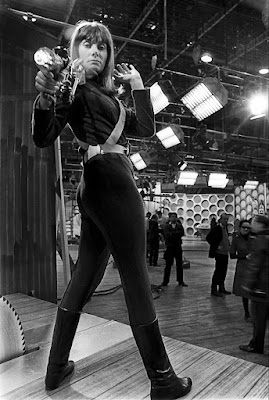
  • The newspapers covered Jean Marsh's arrival in the series on the day of broadcast, illustrated with images taken on the day of recording the seventh episode, The Feast of Steven. The Cathy Gale / Avengers connection was stressed.
Saturday, 2 December 2023

Wild Blue Yonder - a review


This is the one we knew nothing about.
We found out early on that there were to be three special episodes for the anniversary, thanks to clapper boards seen on location. We knew that the third of these starred Neil Patrick Harris, and a tweet from RTD2 quickly led to the guess that he was playing the Toymaker. We also saw actors dressed as Wrarth Warriors and the Meep on location - with the clapper boards indicating that the old DWW comic strip The Star Beast was being adapted as the first special.
But the second episode remained a mystery. All we had to go on were some cryptic teasers and then the fuller trailers, which only depicted Tennant and Tate in some futuristic environment. 
The poster-style artwork then added an odd, crooked robot, and determined fans found one other actor involved thanks to their agent's website.
A very brief synopsis, and the final trailer, indicated that the TARDIS disappears - leaving the Doctor and Donna trapped somewhere referred to as Hostile Action (as in HADS, the ship's HA Displacement System, which shifts it away from danger). 
And that was it.
In the week running up to Wild Blue YonderRadio Times informed us that there was no preview, and we didn't get the usual batch of publicity images until a few Doctor / Donna shots dropped out.
Like Nature, fandom abhors a vacuum, so the lack of information got people speculating like crazy. Perhaps this level of expectation might prove impossible to satisfy...
Well, now we know...

Last week's episode ended with the TARDIS going out of control thanks to Donna spilling coffee onto the shiny new console, and Wild Blue Yonder follows on directly from this. (RTD2 had said that although each special would be standalone, they would have a cliffhanger into the next).
Before arriving on the spaceship, we have a brief encounter with Isaac Newton. The Fourth Doctor had already claimed to have inspired his work on gravity - but this could always have been taken as a joke.
No doubt some will object to the colour-blind casting of the great scientist. I'm okay with it, but can see how making some children think he was of their ethnicity when he really wasn't might be an issue for some. (The programme gave up teaching people about science a very long time ago, but educating about history at least managed to last a little longer). 
Newton misremembers the word "gravity" and we then see Donna use the new term - "mavity"... This was something discussed between Vicki and Steven in The Time Meddler - how a change in history will instantly feed through all future history to the present.
This is picked up in the Unleashed episode as Tennant tries to explain the concept to Tate.

When we do get to the spaceship, we're immediately reminded of Event Horizon
(I certainly was. Not only is it designed like one long corridor, and it's apparently abandoned, but turns out there's a nightmare on board - something which very much messes with your mind. It hails from another dimension, and can take on the appearance of someone you know. Sound familiar?).
There's a lengthy build up to the introduction of the threat. We have to make do with the mystery of a seemingly deserted ship lying on the edge of the universe. Except we've been party to the fact that someone or something has been watching the TARDIS pair.

It's a two-hander for the first half hour, as the Doctor and Donna struggle to work out what's going on. But then we suddenly see that there are two Doctors, and then - after a short while - two Donnas... 
The way this is handled is very well done. The Doctor and Donna have split up to carry out some task. The second Doctor turns up first, and we instinctively know there is something just a little off with the way he acts. But then he mentions something only the Doctor would know, and so we relax...
However, we then cut to where the real Doctor is, and suddenly realise that that was a false Doctor with Donna after all. Then, just as we're thinking there's a shapeshifting creature on the ship, the second Donna turns up.

The way in which the duplicates initially struggle to get to grips with their unfamiliar humanoid forms was nothing new. We've seen bodysnatcher scenarios (especially John Carpenter's The Thing) within the series before. As well as Flatline, it was also impossible to view this episode without thinking of Midnight
It was that episode, with bells and whistles. 
That's not to say that this was completely unoriginal. It may have borrowed from other works, but the packaging certainly felt fresh. Great design and VFX. The four-way dynamic was interesting. We had two mysteries to solve throughout the episode: who were the duplicates, and what was going on with the robot and those occasional random words. The resolution to the latter was pretty clever, though who the beings were, how they functioned, and why they did what they did was the bit we'd seen before. 
If there's one issue I have with this episode, it's the way it hinges on these two mysteries. Once you know what's happening, how often do you think you might watch this again? 
Having nothing going on elsewhere, and with no other characters to relate to, this may not be the sort of episode you revisit very often. 

I'm sure a more psychological horror isn't going to go down well with everyone - especially those who were hoping to see an old monster / companion / Doctor. 
(Chamber pieces don't go down well with everyone. In the DWM poll recently, Heaven Sent came out top story of the last 60 years. Setting aside the stupid voting system they imposed this time, designed so that it didn't upset Colin Baker or the entire previous production team, I had no problem with this, having given the episode top marks myself. It has a remarkable performance by Peter Capaldi, and script by Steven Moffat. Even though they liked it, some fans just couldn't cope with a newer story being top dog, and wanted to see a Bob Holmes story instead). I think some people will criticise Wild Blue Yonder not for the episode on it's own merits, but for how much it deviates from their expectations. 
You can't fault a story for failing to be something it was never meant to be. Just because it didn't match your expectations... that's your problem, not the episode's. 
Not every actor pairing could have pulled this off (I'm visualising another Doctor and companion pairing right now, and OMG it's dreadful...). Tennant and Tate can, and do. 

The episode ends with a glorious but bittersweet reunion, for there in Camden waiting for the TARDIS is Wilf Mott. Unleashed featured a short, but heartfelt, tribute to St Bernard. It also gave us a pretty pointless clip from The Giggle. We did get a trailer this week following the episode itself, though in the gap between programmes rather than as part of the closing credits. (Still not heard the closing theme properly). This showed the start of the regeneration, which takes place in the TARDIS, then a shot of Ncuti's Doctor.

Friday, 1 December 2023

What's Wrong With... The Ribos Operation


Very little, truth to be told, which is surprising. 
The writer, Robert Holmes, did not like "shopping lists" from the producer / script editor. He much preferred the freedom to do his own thing.
In at least one interview, Holmes cited The Ribos Operation as his favourite story, despite it having to include the Key to Time. Not only that, but it had to launch the whole integrated season.
A few minor issues / questions can be identified however...

For a start, how can a time machine travelling through the Vortex detect the movement of an object travelling in normal space / time? 
Why does the Doctor have to work out what the segment is disguised as? Why disguise them at all? No-one is going to work out what an oddly shaped crystal is / does, and as they're spread through the cosmic history it's highly unlikely anyone would obtain more than one.
Why couldn't the Guardian have just told him what to look for? Is it that even he doesn't know?
Is there an even higher power which scattered and disguised them in the first place?
The Guardian never explains why it is the Doctor who has to go get the segments - and the Doctor never asks.
Why is the Doctor allocated a companion? As he says himself, they can often be an added hindrance.

Where did the Jethrik lump usually live? Why have the locator seek it when it's been placed into an even more difficult to access location? As we'll see throughout the season, the locator appears to pick the time and place when it is most difficult and dangerous to obtain the segments.
Why was Binro persecuted when you have people like the Seer acting as a professional mystic, with magical powers?
The Seer leads everyone to the Concourse but Unstoffe has already left. The Graff isn't to know this: to him she's simply wrong - so why continue to be guided by her?
Where on Earth is Garron supposed to come from? His accent varies considerably.
Why does a hardened warrior-prince like the Graff fall for Unstoffe's Jethrik tale, when it is so obviously dodgy? 
The Graff kills the Seer. She didn't see that coming...

New SFX Magazine


A nice bundle of goodies with the latest issue of SFX, in shops from today. Double-sided poster, art cards of The Collection artwork and a bookmark. (The other side of the poster depicts the Doctor and Rose from the Rose graphic novel). 
The magazine itself has a lot about the Christmas Special, though there is also a summary of the various offerings from the anniversary week and a look at the opening titles of the classic era through the years.