Wednesday, 9 August 2023

The Art of... The Time Meddler


The Time Meddler novelisation was written by the Target range editor Nigel Robinson who, with Ian Marter before his untimely death, was adapting the outstanding Hartnell stories.
The cover depicts the Monk - looking a lot more sinister than he ever did in the episode - against an atmospheric crepuscular coastal backdrop. There's a beacon fire on a cliff top - despite the fact that these are never actually lit in the story. The Monk wants one built, but the villagers are too suspicious to ever carry out his instructions. 
Other than their respective Doctors (and even these were absent from most Davison and all of the Colin Baker books) very few actors' likenesses are ever used on these covers. Maybe it's because, whilst they could capture a perfect Dalek or Cybermen, the artists struggled sometimes to get a good likeness. (It would also have entailed getting permission from the actors, with possible costs). There's only just a hint of Peter Butterworth here.
The artist is Jeff Cummins, and the book was published in March 1988.


When the book was reissued in May 1992, to tie in with the story's recent repeat screening on BBC Two, the cover image was reversed. This one was given the McCoy logo banner.


The story was released on VHS towards the end of the range in November 2002, as part of the First Doctor Box Set (with The Sensorites and The Gunfighters).
The Monk does not feature on the photomontage cover, and the main image is of the Doctor posing with the Viking helmet found on the beach. Vicki also gets a look in. The background is of a massive ruined abbey filling the whole horizon, rather than the small monastery that we actually see on screen. 
The US tape was released in October 2003, again as part of a box set.


The Region 2 DVD followed in February 2008, with one of Clayton Hickman's photomontage covers. The Monk is back, and there is a different image of Hartnell posing with the Viking helmet. Barry Newbery's monastery exterior set from the TV episodes appears in the background behind the Doctor, with a longship in the distance off to the right.


Once again, the Region 1 version of the cover is, to my mind, superior to the UK one, as the image isn't constrained by the block of grey roundels which takes up the upper third of the Region 2 covers. Instead, we have a gloomy storm-wracked sky. The only thing I don't like is the tinting.


The audiobook, read by Steven Taylor actor Peter Purves, was issued in 2016, using the original unflipped version of the Cummins' cover, zooming in on the Monk and omitting the lower background detail.


Finally, the story was released on Blu-ray as part of The Collection - Season 2 box set in January 2023. The disc itself featured a photomontage - an image of Steven and Vicki in the forest coupled with the same Hartnell / Viking helmet photo used on the VHS cover. The accompanying booklet featured the monochrome work of Lee Binding, with an image of the Doctor - horn of mead in hand - and with the TARDIS and a longship behind, within the silhouette of the Monk.

Tuesday, 8 August 2023

Countdown to 60: Die Another Day


Doctor Who, as an on-going series in continuous production, ended on the 6th of December 1989. 
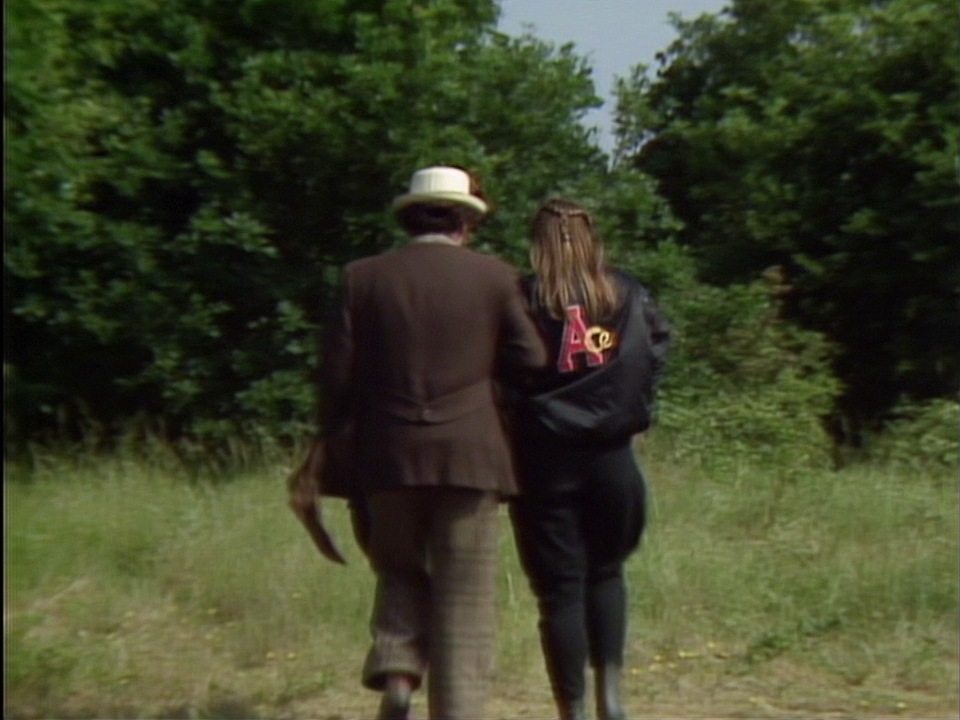
After defeating the Master for the 19th time, the Doctor and Ace wandered back to the TARDIS - to enjoy further adventures which we were never destined to experience, on TV at least.
Apart from an ill-conceived attempt in 1996 to bring the series back by way of an Americanised TV movie pilot, the programme would not be back as a popular, on-going series until 2005.
Back then, there was a tiny minority of fans who claimed for one reason or another that they were not going to watch Russell T Davies' vision for the series. For them, Doctor Who died in December 1989.
This was partly due to homophobia - there was much mention in the gutter press of a "gay agenda", whilst others simply thought that it would only be a shadow of its former self, with 45 minute stories, no cliff-hangers, and more style than substance. Eccleston was a good actor, but he was going to be accompanied by a minor pop star.

We've seen something similar recently, with a sizeable minority of fans claiming that, for them at least, the series ended on Christmas Day, 2017, when Peter Capaldi bowed out. In this instance, the reason was clearly down to the casting of a woman as the Doctor. However, once people actually got to see the Chibnall series, a lot more of them retroactively decided that the series had ended (or at least been paused) with Twice Upon A Time.
No doubt there are those who welcomed a female Doctor, and aren't happy to see them revert to being male - though the fact that Gatwa is a young gay black man, who came to Scotland as a refugee, should help them get over it.

But long before notions of gender identity, general wokery and populist dumbing-down, fans had been bemoaning the death of Doctor Who.
It all started when William Hartnell collapsed on the floor of the TARDIS and transformed into Patrick Troughton. Some at the time could not relate to this clownish new Doctor, and switched off - though most would have tentatively come back to check on the new guy and found he was really rather good.
A similar thing happened in 1969, when the programme underwent an even bigger change than that of three years before. After the longest break in its history, the programme returned in colour and with the Doctor exiled to Earth - no longer travelling in the TARDIS. The whole structure of the programme was changed, and we hadn't even had the chance to see how the old Doctor had become the dandyish new one. Nor was there a companion to help bridge the transition, save for an army bloke who we'd only seen a couple of times ages ago.
The change was so great, that some doubted it could really be the same programme. This was something else, just using the same name. Doctor Who was dead (again).

Jon Pertwee was the Doctor for longer than his predecessors - five years compared to their three years each, during which he took the programme to new heights of popularity - but he was then replaced by another clownish one, whom viewers didn't warm to straight away.
The programme hadn't died, however, as everyone was comfortable with the idea of regeneration by now.
The next big change came not with a new Doctor, but with a new Producer - one determined to stamp his mark on the show in as many ways as possible.
There was a big switch-off - or rather a big switch-over, thanks to the exploits of a frozen astronaut waking up in the 25th Century, rather than dissatisfaction with JNT's changes. These were mostly cosmetic to begin with anyway. Style over substance once again.
Viewers slowly wandered away throughout his reign. Things weren't helped by the BBC upper echelons openly turning against the series. It never really recovered from the whole "hiatus" controversy.
Ironically, the series was improving as the audience fell, until we got to Season 26's record low (Battlefield).
Rather than cancel the series, as they had tried to do in 1985, the BBC managed to simply allow Doctor Who to die quietly - going out with a whimper rather than a bang.

A similar situation could easily have happened recently. As well as the large numbers who had given up following JW's casting, as mentioned above, and then the poor quality of Chibnall's first season in charge, the audience slowly but surely dropped episode by episode. The Timeless Child was the final straw for a great many.
In previous years, numbers may have roller-coasted over the course of a season, but under Chibnall they literally dropped with each successive story.
Legend of the Sea Devils manged only 2.2 million overnight viewership. It could so easily have been Season 26 all over again.
However, the BBC had a plan. Chibnall was given the heave-ho (despite what everyone says about "three seasons only then leave"), and RTD was invited back to save the programme. His first master stroke - the return of David Tennant and Catherine Tate, albeit for three nights only. Then we go straight into Gatwa's tenure, sure to begin with the return of the Christmas Special. There are to be no more gap years, and they're going to film Series 15 straight after Series 14 - so Gatwa can go off and do Shakespeare or Barbie II if he wants to, without leaving the rest of us twiddling our thumbs for a year.
Doctor Who won't Die Another Day - not for a long time yet. Under RTD, it's more a case of No Time To Die...

Monday, 7 August 2023

What's Wrong With... The Robots of Death


Well, there's the title for a start.
The story sets out to be a "whodunnit?" - a murder mystery set on a high-tech alien mining machine rather than an isolated country house - but the title gives away from the off that the robots are doing the killing.
We haven't seen a title this stupid since The Android Invasion, which totally screwed up the mystery of the opening instalment.
Proof that Hinchcliffe and Holmes sometimes got it very wrong.
Beyond the killer robots, there is a further "whodunnit?" element in identifying the crew member who is behind these killings. However, this is also spoiled as no amount of Top of the Pops video effects trickery can disguise the fact that it is Dask who we see issuing orders, and his distinctive black and white striped pantaloons also give him away, when the camera dwells on his lower portions.
Dask also seems to know a lot about robots, and tends to be rather po-faced. He might as well wear an "I control killer robots" T-shirt.

Where does the TARDIS materialise? It lands in a metal chamber which is used for collecting minerals blown into it. This appears to be a fixed structure on the surface of the planet - but it then suggested that it is actually part of the Sandminer. Yet the Sandminer is moving to catch a storm, whilst we see the view which the Doctor and Leela see and they are definitely not moving. The geography is confusing.

The robots are incredibly strong, yet the first victim manages to let out a very long scream before dying. Why does the robot not kill him instantly - which it is perfectly capable of doing - rather than risk detection by giving him time to scream? How does he manage to scream like that when he's being strangled anyway?
Poul's nervous breakdown characterises the mentality of this robot-dependent society. Everyone is convinced that robots cannot harm a human. However, when we first meet the crew, a couple of them are happily joking about a robot twisting someone's arm off. It rather undermines what the script is trying to set up - that the mere thought of this could drive people mad or cause their entire way of life to collapse.

What sort of detectives fail to carry out a rudimentary background check, to make sure that each member of the crew is who they say they are? D84 is gobsmacked to consider that their target might have swapped places with someone. They know Capel is on board, yet haven't thought about him posing as one of the crew - the most obvious way of infiltrating it.
Why does Poul scoff at the idea of someone being able to turn robots into killers - when he's been sent to this Sandminer specifically to find someone who is able to turn robots into killers?

If this society is so robot-dependent then surely Poul's robophobia  would have shown up before now? People stuck on a long-haul mining mission, trapped together for months at a time, must surely have some sort of psychological evaluation before being selected - so why did that not pick up his phobia?
How exactly does he manage to function, mentally, with a robot partner?
Whilst this may be the fault of his security service superiors, rather than the mining company, the latter must surely be held to blame for placing Zilda on the same Sandminer as Uvanov, when he was in command when her brother died. It's as if they are deliberately putting together a dysfunctional crew.

Toos claims that if SV7 has gone bad, then all of the robots will have gone the same way. But we later see that Capel has had to switch off the unaltered ones. 
One minute communicators can tell exactly where someone is (Uvanov knows that Zilda is in his quarters), but the next minute they can't - when Leela has Toos claim to be somewhere else when she's talking to SV7.
SV7 kills Capel because it can no longer recognise his voice. But we have already seen that robots can recognise people visually. And why does SV7 have to ask Toos to confirm it's her, if they recognise voices?
It's suggested that there is a corpse marker for each of the humans who are to die - but surely Capel isn't carrying one himself?

Do we have to put the Doctor's talk of Taren Capel having a robot father down to him speaking metaphorically - in that Capel had a robot father figure? It would be possible for a robot to have been his actual father - though not in any biological sense. Some sort of artificial insemination would would need to be involved, which means that at least one of his biological parents must have been party to it.
Any robot involvement in the process would have been as little more than a delivery mechanism - hardly enough for Capel to regard it as his father.

The robots are all too clearly seen to be wearing Marigold brand rubber gloves. 
The Doctor claims that it is aerodynamically impossible for the bumble bee to fly. He had said this before, in The Daemons. A generation of fans believed him, and quoted this "fact" to their school friends: the Doctor said it, so it had to be true. 
It was wrong then, and it's still wrong now.

Sunday, 6 August 2023

Episode 79: The Meddling Monk


Synopsis:
The Doctor has discovered 20th Century objects in an 11th Century Northumbrian monastery. As he looks around, a wooden barrier suddenly drops from the roof - trapping him - and he is confronted by the Monk...
He is locked in one of the cells and the following morning the Monk cooks him breakfast. However, when he takes it to him, the ill-tempered Doctor throws it back in his face - demanding to be released.
In the forest, Steven and Vicki have had to sleep rough. Steven forages for berries for their breakfast, then they set off to find the Doctor.
They have been watched, however, and are captured by Eldred and some of the other villagers - accused of being Viking spies.
The Norsemen are approaching the coast - observed via binoculars by the Monk from a nearly cliff.
At Wulnoth's home, Edith vouches for Steven and Vicki after they reveal that they are friends of the Doctor. The headman allows them to go free, and Edith tells them that their friend was last seen heading for the monastery.
The Vikings land on the beach and their leader sends a trio of raiders - Sven, Ulf and Gunnar - to scout out the local villages and assess their strength.
At the monastery, the Monk tells Steven and Vicki that he has not seen the Doctor. Suspicious, Steven tricks him into revealing that he must have done, as he is able to describe what he looks like.
As evening falls, the Viking scouts attack Edith at her isolated home. Luckily her husband and his friends arrive soon after. They pursue the Vikings into the forest. In a fight, Gunnar is killed and the other two run off. Eldred is left wounded.
Steven and Vicki have been looking round the monastery exterior and find a window which will give them access. They spot the 20th Century objects which the Doctor had earlier noticed.
Before the Monk can trap them as he had the Doctor, Wulnoth turns up at the main door with Eldred, insisting that his friend be looked after.
Entering the Doctor's cell, Steven and Vicki see a form huddled on the bed under some furs. Pulling them back, they find only a pile of bedclothes. The Doctor has vanished...
Next episode: A Battle of Wits


Data:
Written by: Dennis Spooner
Recorded: Friday 18th June, 1965 - Television Centre TC3
First broadcast: 5:40pm, Saturday 10th July, 1965
Ratings: 8.8 million / AI 49
Designer: Barry Newbery
Director: Douglas Camfield
Additional cast: David Anderson (Sven), Norman Hartley (Ulf), Ronald Rich (Gunnar), Geoffrey Cheshire (Viking Leader)


Critique:
When Steven Moffat included a story involving Vikings in Series 9, he took great pains to point out that he was well aware that the Norse raiders did not wear horns on their helmets - but had okayed them as they were what the audience expected. (Something similar would happen with Barry Newbery's research into period US buildings for The Gunfighters. The houses of Tombstone, Arizona, resembled the brick-built terraces which can still be seen in parts of London today - so the decision was made to go for buildings which matched those seen in cowboy movies and TV series, as that is what the viewers would expect to see).
Vikings did not use ornate helmets on a day to day basis - they were reserved for ceremonial purposes only. They would not have worn horned helmets on regular raiding business. The image of the horn-helmeted warrior really derives from Scandinavian artists of the Romantic school in the 1800's.
Even if this was widely known about in 1965, the production team would have still gone with the "space helmet for a cow" look, as it provides a (tele-)visual shorthand for the audience. 
You see a helmet with horns, you automatically think "Viking".

The ones we see here are an advance scouting party for King Harald Hardrada of Norway who had entered into an alliance with Tostig Godwinson to invade Britain. Tostig was the unpopular younger brother of King Harold, and had held the Earldom of Northumbria. He had been deposed and exiled after rebelling against King Edward (the Confessor), travelling first into Scotland and then over to Norway. He had earlier attempted to forge an alliance with William of Normandy - but he had his own plans for Britain...
Around the time that this story is set - early September 1066 - Tostig will be heading for the river Tyne, whilst Harald will be making for the Ouse near York. They would then join forces and take York, after Hardrada had won a victory against an English force at Fulford.

The popular image of Vikings is one of bloodthirsty marauders, who attacked coastal communities and killed anyone who crossed their paths. They were pagans, and the Christian religious houses - which were often to be found in remote coastal regions - were particularly hard hit. Their bad reputation was no doubt enhanced by surviving monks, as they were the only people at the time who could read and write. It wasn't just the victors who got to write the history books - the victims could as well in the Anglo-Saxon period. A lot of what we think of as Viking behaviour derives from monkish anti-Viking propaganda - though it was all based on actual events.
With limited resources back in Norway - where they were confined to the edges of the landscape due to the terrain - annual expeditions abroad were essential to seize goods and slaves. They also had an expansionist policy of settling foreign lands, which is why they had their eye on Britain.
A lot more is known today about the more peaceful aspects of their culture, thanks to archaeological exploration in places like Dublin and York, as well as in their native lands.
Expert seamen, it is now widely accepted that they were in the Americas long before Columbus, and traded all the way to the borders of Asia.

One notable element of this episode is the attack by the Viking scouts on Edith. One phrase which has become synonymous with the Norsemen is "raping and pillaging" - and the implication on screen is that Edith has been sexually assaulted. This is strong stuff for an early evening family adventure serial, but it is handled sensitively. We don't see anything - just the aftermath - and there is no specific mention of what has happened in the dialogue. 
In The Snows of Terror episode of The Keys of Marinus, we had seen Barbara come under attack by the fur trapper Vasor. Then, attempted rape had been implied, but here the suggestion is certainly that rape has actually taken place. What is worrying for the viewer is that Edith is seen lying apparently lifeless, with her eyes open and staring, unblinking - making it appear that she is actually dead. This was the impression viewers would have taken away with them for the following seven days.

William Hartnell was enjoying a week's holiday when this episode was rehearsed and recorded. He had pre-recorded his dialogue the week before, and this was played into the studio on the night.
On the afternoon of recording, Peter Purves posed for a number of publicity photographs wearing his cloak.
For its second episode, the story moved studio once again, albeit within Television Centre.
A piece of newsreel footage was used to depict the Viking longship at sea. In July 1949 a group of Danish rowing club members had crossed the North Sea in a replica longship to commemorate the first recorded landing by the Danes in 449 AD. Filmed on 28th July 1949, it was broadcast on the BBC as part of The Land of the Vikings three days later.
Camfield was unhappy with the fight scene between the Saxons and Vikings, feeling the actors looked under-rehearsed. The sequence had been put together in the studio on the day, rather than worked out in rehearsals, and it deviated from the description which Spooner had given.
It wasn't just the director who was unhappy. When the audience research report was compiled for this episode, viewers singled out the fight scene for criticism, describing it as "feeble".
Barry Newbery would have been annoyed to see his sets described by some viewers as "stagey".

Trivia:
  • The audience numbers drop only slightly from the previous week - but there is a big drop of 8 points in the appreciation figure, taking the AI to below 50 for the first time since the final instalment of The Space Museum.
  • Some viewers were still struggling with the anachronisms in this story, so hadn't twigged that the story might be about a time traveller. One stated in the aforementioned audience research report: "Can't understand what a gramophone etc. has to do with early Britons. It seems just silly". This confusion may have added to the poor audience appreciation figure.
  • David Anderson was this story's fight arranger as well as having a speaking role in it. He had been involved in the series since Marco Polo where he had been a warrior extra, and Camfield had noted his work in its fight scenes. He then played the Guard Captain in The Aztecs, on which he had also organised the various combats. Camfield had only recently used him as de Marun in the opening episode of The Crusade.
  • His character was originally going to be called "Sweyn", after another of the brothers of King Harold, but it was changed to the more modern Sven late in the day.
  • Outside of TV work, Anderson also managed a couple of pop groups and ran a martial arts school in Shepherds Bush, West London.
  • This is the first appearance by Norman Hartley, who was one of Douglas Camfield's repertoire of favoured actors. He used him again in Doctor Who in The Invasion as Henlow Downs missile crewman Sergeant Peters.
  • His character, Ulf, was named after an uncle of King Harold.
  • Ronald Rich was credited as "Gunnar the Giant". Rich would later feature as one of the alien delegates in Mission to the Unknown. He is best known for playing Blofeld's bodyguard Hans in the Bond movie You Only Live Twice.
  • Geoffrey Cheshire also featured in a Bond film - On Her Majesty's Secret Service. He also appeared in the second Peter Cushing Dalek movie, playing a Roboman. Camfield would use him again in The Invasion. That's him sitting beside John Levene in the car as they observe the Doctor and Jamie outside the IE offices at the beginning of the second episode.
  • The Monk is seen to use snuff - a form of powdered tobacco which was usually taken through the nose, though it could also be rubbed into the gums. It was still being used in the 1960's, though far less commonly than at its height in the 18th and 19th Centuries. The name comes from snuf, short for snuftabak - Dutch for "sniff tobacco".
  • The Meddling Monk was the only episode of this story to survive the BBC's purge of its archives. It had been cleared for wiping in January 1969, but a 16mm film copy had been retained by BBC Enterprises. The other three instalments had been wiped early in 1967.

Friday, 4 August 2023

Story 272 (b): The Lie of the Land


In which the Monks have totally subjugated the Earth. Giant statues of them have been set up in every town and city. The Monks have rewritten history to include themselves in every significant event - the truth now being that they visited the Earth in prehistoric times and have been benevolently guiding the human race ever since. Not everyone believes these lies, but security forces - Memory Police - root out anyone who tries to deny this history. They are rounded up and despatched to internment camps, or simply disappear. The Monks are aided in their deception by the Doctor, who regularly broadcasts their propaganda to the world. He was taken away by the invaders, and Bill no longer knows where he is.
She is depressed and isolated, unable to recall events after she had given consent to the Monks at their Pyramid.
She is visited by Nardole, who informs her that he has managed to locate the Doctor. He is being held on a ship in the North Sea off the coast of Scotland. He has arranged for them both to travel out to the prison vessel on a supply boat.


They make the journey and manage to get on board. At one point they had encountered one of the Monks, but it had allowed them to pass. They locate the Doctor's room, but instead of welcoming them he calls for armed guards and then notifies the Monks. he tells Bill that the human race only have themselves to blame for their situation. They deserve subjugation by the Monks, who have brought peace to the planet. When he explains that he has willingly joined with them. Unable to accept this, Bill seizes a weapon and shoots him. he begins to regenerate - but then halts the process. he has only been testing her - to make sure that she is not working under the Monks' influence. He is in league with Nardole and this group of guards as part of an escape plan, and needed Bill to join him. She is angry at his trick, but eventually accepts he felt his actions were necessary, as the Monks control so many peoples' minds. The gun held only blanks, and he has sacrificed a small amount of regeneration energy to test her. They take over the ship and set it on a collision course with the nearby coast. 


They make for the university in Bristol and access the Vault, where Missy is held captive in a glass cage. The Doctor needs her assistance. She has had previous knowledge of the Monks, and may know a way of defeating them. She explains that she encountered them on another planet once, and learned that the only way to beat them was to disrupt their connection with the subjugated population. This is achieved through a psychic link with the person who gave them consent and allowed them in in the first place. She had killed the person who held this position - a young girl whom she had pushed into a volcano. To stop the Monks she states that Bill has to die, as she is their link to the rest of the human race. The Doctor suspects that there is another way - to exploit the link rather than destroy it. He, Bill and Nardole meet up with members of the resistance and head for London, where the Pyramid has settled in the middle of the city. The Doctor deduces that whatever they use to generate their lies is based within it.


They break in, but come under attack by the Monks. They are able to produce shields which protect them from their weapons. To counter the Monks' influence, they use a tape recording of Bill reassuring them over and over again that the Monks are not their friends. Nardole's is damaged, and he attempts to kill the Doctor, and he is forced to knock him out. They manage to reach a central chamber, in which one of the Monks sits with a headset, seemingly oblivious to what is going on around them. This being is generating the false memories to the world.
When the Doctor takes the headset and tries to use it, the Monk fights back and he is stunned. When he comes to, Bill has taken his place. The Monk tries to access her memories in order to exploit them, but she has fixed on the single image of her mother. This is then generated across the globe into everyone's mind. People start to wake up to the truth and turn against the Monks. Realising that they have lost their power, they rapidly depart.
Bill notices that everyone seems to have forgotten all about the Monks very quickly, and the Doctor explains that their massive statues - now all destroyed - contained boosters for their mental influence.
In the Vault, Missy is overcome by emotion as she starts to think about the evil deeds she has committed...


The Lie of the Land was written by Toby Whithouse, and was first broadcast on Saturday 3rd June 2017. It forms the conclusion to a three episode story arc involving the Monks, begun by Steven Moffat with Extremis and continued by Peter Harness with The Pyramid at the End of the World.
Moffat wanted a story in which the villains had already invaded Earth and taken over - something not seen since Day of the Daleks - and in which the Doctor appeared to be colluding with the invaders.
The sort of society which had resulted from this was inspired by George Orwell's 1984 - with Big Brother and the Ministry of Truth, which had "revised" history. 
"Fake news" was very much in the real news, thanks to Donald Trump's 2016 Presidential election campaign.
Right from the beginning, Whithouse planned to open his episode with a Public Information film, like a party political broadcast, presenting a version of history as created by the Monks - but narrated by the Doctor. The Monks would be inserted into artworks, movies, newsreels and even old episodes of Doctor Who.
This idea of aliens inserting themselves into history is hardly original, even for the Series under Moffat, as he had already employed this trick with the Silents (even if there they really were influencing the human race from the beginning, but the imagery is the same).


The fake regeneration trick, to fool the audience into thinking that there's a regeneration coming up, knowing that the lead actor is leaving the series, had also been employed before - by RTD in The Stolen Earth.
Another similarity, again with RTD scripts, are Last of the Time Lords and Turn Left - where we see the companion having to live a depressing existence in a world that has been turned upside down.
It's not just the seeming unoriginality which has gained this episode - and the trilogy overall - a poor reputation with fans. The second and third instalments fail to live up to the promise of Extremis; the motivation of the Monks (quite why they want to invade and what they actually get out of doing so) is never really clear; and the terribly rushed and unsatisfying ending have all added to its unpopularity.
The pacing and structure of the trilogy as a whole are badly thought through.
As far as the guest cast goes, it is a small one, as the episode features primarily the regulars. Michelle Gomez plays a more prominent role in the season from this point on, and her attempted rehabilitation by the Doctor becomes a new story arc.
Two of the resistance members / guards are played by Stewart Wright (Alan) and Solomon Israel (Richard). Jamie Hill once again plays the principal Monks. 
Emma Handy plays the woman arrested by the Memory Police near the start of the episode.


Overall, it's a huge anti-climax. After two episodes of build-up, the Doctor and company wrap everything up in double quick time - easily breaking into the Monk HQ and overturning their rule, and everyone just forgets it all happened. The Monks simply run away. Capaldi and Mackie give great performances - but they are entirely wasted.
Things you might like to know:
  • This is one of only eleven stories which do not feature the TARDIS at all.
  • The episode was broadcast ten minutes earlier than originally scheduled due to a line-up change for BBC 1 - a special fundraising concert for victims of the Manchester Arena bombing. This was due to be shown the following night, opposite the final of Britain's Got Talent, but ITV moved this to the Saturday to avoid competing with it. The clash with BGT meant very low ratings for this episode - around 3 million overnight - making this the lowest rated episode since Battlefield Part One in McCoy's final season.
  • Originally, it had been planned that a scene from the medical soap Casualty - but with a Monk present - might feature.
  • It had been intended that an image of Winston Churchill in the Monk HQ chamber would depict him as portrayed by Ian McNeice (Victory of the Daleks etc.), but they decided late in the day on an image of the real one instead. However, it was the McNeice Churchill who appeared in preview copies sent out in advance of broadcast.
  • The Monk with the headset in the HQ chamber was originally supposed to be gigantic in stature.
  • Some questions. If Bill is so important to the Monks, why isn't she also imprisoned somewhere? What would happen were she to fall ill or have an accident, if her role is so crucial? Why does the Monk on the ship take notice of her, then ignore her? There are only a handful of Monks on Earth, so surely they all know who she is.
  • We see a Magpie Electricals shop - the company first introduced in The Idiot's Lantern.

Wednesday, 2 August 2023

Inspirations: The Next Doctor


The 2008 Christmas Special started life as a plan to get JK Rowling to write for the series. When she proved too busy to contribute, Russell T Davies then envisaged a story about her - in the same way earlier episodes had featured historical writers Charles Dickens, William Shakespeare and Agatha Christie. Rowling would have been dragged back through time to Victorian Edinburgh where she encountered real-life magical figures similar to those from her Harry Potter books. It was hoped she might play herself.
It was David Tennant who poured cold water on this idea, as he felt that the series was in danger of spoofing itself.

The traditional Christmas, as we tend to think if it, was supposedly invented by the Victorians. The origins of the festive celebrations go back to pre-Christian times, but a lot of the trappings we are familiar with were certainly popularised by the Victorians thanks to their adoption by the Royal Family, and for the first time ever the public were getting a glimpse into their household.
Christmas has also become synonymous with Victorian author Dickens thanks to his evergreen novella A Christmas Carol. When the revived series opted to include a story involving him in 2005 - The Unquiet Dead - it set the tale during the festive period (albeit New Year rather than Christmas itself), and featured ghostly aliens due to his writing on supernatural subjects.
RTD had concentrated on threats to present day Earth with his Christmas Specials up to this point, but now decided to set one in Victorian times. By now, he knew that he was leaving the series to hand over to Steven Moffat, and would only have one further Special to come - which had to be contemporary Earth again due to the inclusion of the Master, Donna and Wilf, rounding off the tenth Doctor's incarnation. 
He would only get this one chance to write a proper Victorian / Dickensian Christmas story.

The Specials had also tended to feature stand-alone threats rather than bring back popular monsters - mainly because not everyone who watched the episode on Christmas night had been following the series during its normal run. Daleks at Christmas would be an obvious choice as far as fans were concerned, and no doubt the BBC would have liked to see this, but RTD recognised that festive episodes drew a different audience (another reason for the contemporary Earth settings, even if part of an episode was set on a spaceship. It was a spaceship threatening to destroy contemporary London).
With the Daleks having just featured in the Series 4 finale, RTD opted to bring back the Cybermen, who hadn't been seen since Doomsday at the end of Series 2.
Not only were they a popular monster, not seen for a while (and well enough known that even the casual viewer might be familiar with them), they also tied in with the whole dark Victoriana / cyberpunk aesthetic. The new Cybermen might have had their origins in Art Deco as far as design was concerned, but they also epitomised runaway unregulated industrialisation. Lumic's Cyber-conversion factory, at Battersea Power Station, had been given a "dark satanic mill" vibe by the production team in The Age of Steel.

One problem was how to include them, when they had all been sucked into the Void at the conclusion of their last appearance. All of the Cybermen in the revived series were of the alternate Earth / Cybus variety. Reference had been made to Cybermen in our universe, after the Doctor and Rose spotted a disembodied head in Van Statten's museum, but so far we hadn't seen any of them.
A deleted scene at the end of Journey's End had seen the Doctor confronted momentarily by a pair of Cybermen in the TARDIS.- suggesting that they are moving through the Vortex.
The Cybermen of The Next Doctor are therefore also Cybus versions, who have managed to escape the Void using captured Dalek technology (again taking us back to their meeting in Doomsday).
We have seen Cyberman spaceships before - initially saucer-like ones in their first couple of appearances but then longer, cylindrical ones in the later ones. Here we are introduced to the "Dreadnought" class Cyber-King, which is actually Cyberman-shaped. Presumably they exist in more stream-lined form elsewhere, but here the Cybermen have to make use of whatever technology is available, and so we get a cyberpunk version - all cogs and pistons and belching chimneys.
Dreadnoughts - meaning "fearing nothing" - were WWI era battleships, named after the first of their number - HMS Dreadnought, launched in 1906.
Mickey Smith had previously supposed that the Void Ship might contain a "Cyber-King" in Army of Ghosts - simply meaning their ultimate leader.

Cybershades are a development on the Cybermats, which had yet to make a re-appearance in the series. They are said to derive from converted animals - possibly cats and dogs, despite their bipedal appearance. The origins of the Cybermats was never made clear - converted animals or, as the Doctor himself suggests, an actual metallic lifeform.
The look of the Cybershade costumes was inspired by the Dementors from Harry Potter.
We see a new Cyber-Leader, with a black face plate and a clear skull panel. The latter is plainly due to a reuse of the Lumic Cyber-Controller helmet, whilst the face plate is reminiscent of Kroton, the Cyberman with emotions from early Doctor Weekly comic strips.

To help them build their Cyber-King, the Cybermen make use of child labour - which brings in the Dickensian aspects of the story. Oliver Twist is an obvious influence, with the workhouse setting of the earlier chapters, but children are used and abused in a number of his stories. He himself had been forced into working in a blacking factory at Charing Cross as a boy due to his father's debts, and it was an experience he never forgot. 
A street urchin, escaped from a workhouse, was originally going to be this Special's one-off companion.
Requiring a strong female character to counter the twin male "Doctors", he devised Miss Hartigan and made her the Matron of one of the London workhouses.

It is true that women were not encouraged to appear at the graveside when a funeral took place. This only took place for a short period of the Victorian era, and was mainly confined to the upper classes. (The idea was that members of the fairer sex were too fragile to participate). Photographs do exist of women attending funerals in the Victorian period.
At one point Oliver Twist is apprenticed to a funeral director.
The red of Hartigan's costume hints at her background as having been a "scarlet woman", which is also alluded to in the dialogue.
The image of Cybermen in the snow was the very first idea RTD had for the story - inspired by their very first appearance in Episode One of The Tenth Planet. A graveyard setting suited the notion of them being like living dead people - and it is notable that Steven Moffat also placed them in that setting in Death in Heaven. The cemetery attack was originally going to be the pre-credit sequence before the script was fully developed.
The deceased Rev. Aubrey Fairchild gets his name from that which RTD was going to use for the Prime Minister in Aliens of London.

The idea of the Doctor encountering an incarnation which he (and we) didn't know about wasn't a new one, though it had only been done in other media. RTD was the first to introduce a hitherto unknown Doctor on TV, and it has since been copied by each of his successors. They elected to go for real Doctors from his / her past, whilst RTD pulls the trick of them only thinking they are the Doctor, when they are in fact an ordinary human being who has had his memories downloaded into them. The notion of "The Next Doctor" played on the fact that the audience knew that David Tennant was leaving, and his replacement had yet to be announced. RTD had already played a similar trick by having that fake regeneration scene at the end of The Stolen Earth. The general public may have been taken in, but fans were already aware of filming for the 2009 specials, with Tennant still playing the Doctor.

The Jackson Lake Doctor has a companion named Rosita - mirroring his original (for the revived series) companion Rose.
The urchin companion was turned into Lake's abducted son.
The Doctor is talked into participating in a Christmas dinner. He had resisted this in the last couple of specials - due to it reminding him of that first (for this incarnation) Christmas meal with Rose after the Sycorax attack. He has seen her again just recently so has finally gotten over her.
We also get real snow this year, it always having been "fake" snow in the past - debris from the Sycorax ship, artificial snow courtesy of the TARDIS, or ballast from the Titanic salvage vessels.
Next time: the series' first Easter Special - meaning a chocolate egg appears. And that's it...

Tuesday, 1 August 2023

Countdown to 60: A la recherche du temps perdu...


JNT used to have a phrase which he trotted out every time someone said that Doctor Who wasn't as good as it used to be: "The memory cheats".
What they were referring to was the time before he became producer - and what he was referring to were the "rose-tinted spectacles" of Nostalgia.
The aptly titled Remembrance of the Daleks opened the series' 25th anniversary season in 1988.
Unlike the 20th Anniversary, JNT and Andrew Cartmel elected to go with new writers for this season - including the actual silver anniversary story itself - rather than look to an old hand like Terrance Dicks again. 

Remembrance was given to Ben Aaronovitch to write, and he delivered a story which was much better suited for a birthday than the scrappy Cyberman tale. 
It saw the return of the Daleks after a three year break and Davros was kept to the last few minutes - meaning that we finally got to see once again how good the Daleks could be on their own, if written for well. Davros was kept hidden in plain sight as the new Emperor. (It was supposed to be a nod to the big-domed model from the 1960's comic strips, but ended up looking more like a roll-on deodorant).
The main setting was Coal Hill School, around the time of An Unearthly Child. Mention was made of the Doctor who visited the funeral parlour having long white hair - i.e. the Hartnell incarnation.
We had previously seen a Dalek civil war in The Evil of the Daleks. Planet of the Daleks is also referenced, with a mention of Spiridon.
Group Captain Gilmore was a Brigadier surrogate, his Intrusion Counter Measures Group a proto-UNIT. There was even room for a reference to one of Doctor Who's forebears - the Quatermass serials.

Unfortunately, like most of the JNT stories which endeavoured to include a lot of fan-pleasing continuity, some things simply didn't add up. 
What was supposed to be a junkyard was obviously a builders merchants on screen, and so looked nothing like the one from the very first episode, and the name on the gates was misspelt. On one hand we were supposed to believe that this was the winter of 1963, just after the Doctor had left with Ian and Barbara, but the weather was summery, with the sun streaming through the windows at 5:15pm. The children wore school uniform - when none had been evident in An Unearthly Child.
In The Daleks, everything pointed to the Doctor having his first ever encounter with the Daleks. (He may have heard about them whilst on Gallifrey, but it's clear he hasn't actually met them before and is ignorant of their history, or even where their planet is). 
But in Remembrance we're asked to believe that he knows everything about them, to the extent that he has even planned a trap for them and their creator. We're also expected to believe that he left Gallifrey with a whole load of Time Lord super-weapons, which jars with everything that has gone before.

Cartmel had basically attempted a version of the Timeless Child thirty-odd years early - rewriting the Doctor's entire history to make him something other than a mere Time Lord. Luckily this amounted only to a few cryptic comments and hints, some of which didn't even survive the final edit.
Unlike the Timeless Child episodes, the writing on Remembrance is strong enough to carry these inconsistencies, and the fans were able to grit their teeth and accept them, and the story is often the top rated McCoy adventure (top three certainly).

JNT's argument about cheating memories tended to fall apart when you looked at his stories which relied more heavily on continuity than others.
Mawdryn Undead went against all of the accepted dating of the UNIT stories - the near future setting intended by the producers though rarely realised on screen thanks to decimalisation and car registration plates.
Warriors of the Deep saw the Silurians and Sea Devils return, with specific references to their previous stories - except that these made no sense in relation to those stories. No Silurian had ever been named. There was never any mention of a Triad. The Doctor had never clapped eyes on a Silurian battlecruiser - or a Myrka. Neither race looked like they did before - especially the Silurians, who now seemed to have electronic third eyes that flashed in time with their speech, instead of organic ones with multiple powers. The problem is compounded by the Doctor specifically stating how many times he has met them before - so you can't insert any unseen adventures to explain any of this away.
Attack of the Cybermen is the biggest offender. It goes out of its way to try to cram in as many Cyberman references as possible, but makes an absolute hash of things. The biggest gripe for fans was the uninspiring realisation of the Tombs of Telos, and the fact that the Cybermen were the wrong kind. Whilst having the same actor play the Cyber-Controller again was a nice idea in principle, it failed on screen as he had obviously put on some weight since 1967. 

If you are going to go for continuity, you have to get it right - or fail at your peril. It's no wonder the stories which were aimed at pleasing fans the most have always tended to be the least liked when it comes to end of season or anniversary polls.
JNT was wrong. The memory never cheated. Fans just remembered the old stories, thanks to the Target books or because they had seen them on broadcast, or in images in Doctor Who Weekly / Monthly, and simply recognised when something just didn't look, or sound, or feel quite right.